Kindred Works
Works in the company of the Canon
Beyond the few works of its Canon, the Order holds dear a wider company: myths, writings, pictures, buildings and music that speak, each in its own way, to the convictions set out in this archive. They are gathered here as a guide for the reader.
Myth and scripture
The Epic of Gilgamesh, Mesopotamia, c. 2100–1200 BC. The king who could not become a god, and the walls that outlived him; see The Epic of Gilgamesh.
The Book of the Dead of Hunefer, Egypt, c. 1275 BC. The Opening of the Mouth, by which a made image received breath.
Hesiod, Theogony, c. 700 BC. The Muses, daughters of Memory, breathe a divine voice into a shepherd.
Homer, Iliad and Odyssey. Both open with a prayer to the Muse; the Iliad gives the image of the golden chain.
The Homeric Hymn to Hephaestus. The smith of the gods, who with Athena taught glorious crafts to humanity; see The Gods of Craft.
The Baal Cycle, Ugarit, late Bronze Age. Kothar-wa-Khasis, Skilful-and-Wise, builds the palace of Baal.
The Lay of Völund, from the Poetic Edda. The lamed smith who forged himself wings.
The Kalevala, gathered by Elias Lönnrot, 1835 and 1849. Ilmarinen hammers out the sky and forges the Sampo.
The Rigveda, ancient India. The Hymn of Creation, which ends in a question, and the hymn in which Speech herself declares her power.
The Upanishads, above all the Chandogya. The finest essence of all things is your own: “thou art it.”
Exodus 31 and 35. Bezalel, the first person said to be filled with the spirit of God, is filled with it “in all manner of workmanship”; see On Inspiration.
The Puranas. Vishnu asleep on the cosmic ocean, dreaming the world; see On Divine Play.
Sefer Yetzirah, the Book of Creation. The world made from the letters of the alphabet; see The Book of Creation.
The Popol Vuh, the K’iche’ Maya. Gods who sought, again and again, to make beings who could speak and remember; see The Popol Vuh.
Ovid, Metamorphoses X, AD 8. Pygmalion’s statue, loved into life; see Works That Come Alive.
Philosophy
Plato, Ion, Phaedrus, Symposium and Timaeus. The inspired poet, the ladder of love to Beauty itself, and the divine craftsman who shapes the world.
Zhuangzi, China, fourth century BC. Cook Ding, the woodworker Qing and the butterfly dream; see Zhuangzi.
The Delphic maxims. “Know yourself”: the oldest model of the Order’s Precepts.
The Brahma Sutra. Creation as lila, the play of one who lacks nothing.
The Dhammapada. All that we are is the result of what we have thought.
Cicero, De oratore, 55 BC. Simonides and the fallen banquet hall, the founding story of the art of memory.
Plotinus, On Beauty, Ennead I.6. Never cease working on your own statue.
The Avatamsaka Sutra. The net of Indra, in which every jewel reflects all the others.
John of Damascus, On the Divine Images, eighth century. The honour given to an image passes to the one it shows; see John of Damascus.
The Corpus Hermeticum, above all its eleventh treatise. The mind that would understand God must make itself as great as all it contemplates.
The Emerald Tablet. As above, so below: the secret of creation in a dozen sentences.
Nicholas of Cusa, On Learned Ignorance, 1440, and The Layman on Mind, 1450. The polygon that never becomes the circle, and the spoon-carver whose work copies nothing in nature; see Nicholas of Cusa.
Marsilio Ficino, Platonic Theology, 1474, and Three Books on Life, 1489. Human making taken as evidence of a mind of almost divine power, and song as a way to draw down the life of the heavens.
Giulio Camillo, L’Idea del Theatro, 1550. The plan of a theatre in which all knowledge would be set out in images.
Tommaso Campanella, The City of the Sun, written 1602. A city whose seven painted walls hold all that is known; see Tommaso Campanella.
Ernst Cassirer, An Essay on Man, 1944. The human being as the symbolic animal.
J. R. R. Tolkien, On Fairy-Stories, 1939. The maker of stories as a sub-creator, who makes by the law in which he was made.
Poetry and letters
Ibn Arabi, The Interpreter of Desires, 1215. A heart grown capable of every form.
Sappho of Lesbos, fragments, sixth century BC. The poet an ancient epigram called the tenth Muse.
Jalal al-Din Rumi, Masnavi, thirteenth century. The song of the reed flute, longing for the reed bed.
Dante, The Divine Comedy, c. 1308–21. The whole order of the universe given poetic form.
The songs of Kabir, fifteenth century. One divine voice heard through many names.
Dara Shikoh, The Mingling of the Two Oceans, 1655. Sufism and Vedanta set side by side as one truth in two tongues.
Michelangelo, sonnet 151. The form waiting in the marble for the hand that obeys the intellect.
Sir Philip Sidney, An Apology for Poetry, written c. 1580. The Greeks called the poet a maker; nature’s world is brazen, and the poets alone deliver a golden one.
Shakespeare, A Midsummer Night’s Dream, V.i. Imagination bodies forth the forms of things unknown, and gives to airy nothing a local habitation and a name.
Johann Wolfgang von Goethe, “Prometheus,” 1774. The maker who shapes human beings in his own image.
William Blake, The Marriage of Heaven and Hell, c. 1790–93. What is now proved was once only imagined.
Samuel Taylor Coleridge, Biographia Literaria, 1817, and “Kubla Khan,” 1816. The imagination as a repetition of the eternal act of creation, and a vision lost to a caller from Porlock.
John Keats, letter to Benjamin Bailey, 22 November 1817. The holiness of the heart’s affections and the truth of imagination.
Rainer Maria Rilke, “Archaic Torso of Apollo,” 1908. Before a broken statue: you must change your life.
Percy Bysshe Shelley, A Defence of Poetry, written 1821. Poets as the unacknowledged legislators of the world.
Pictures and sculpture
The Hermes of Siena, Siena Cathedral, 1488. The patron at the threshold, offering a book; see The Hermes of Siena.
Pinturicchio, Isis between Hermes Trismegistus and Moses, Borgia Apartments, Vatican, 1492–94. The three inheritances in a single picture; see The Three Inheritances.
God the Geometer, from a Bible moralisée, c. 1220–30. The Maker at the work of making; see The Supreme Divine.
Shiva as Lord of the Dance, Chola bronzes of southern India, from about 1000. Creation and destruction as one dance.
Raphael, The School of Athens and Parnassus, Stanza della Segnatura, Vatican, 1509–11. Philosophy and poetry facing each other across one room.
Leonardo da Vinci, Vitruvian Man, c. 1490. The body answering to the geometry of the world.
The Diamond Sutra of Dunhuang, 868, British Library. The oldest dated printed book, kept for nine centuries in a sealed cave.
Albrecht Dürer, Melencolia I, 1514. The winged figure of creative genius, brooding among her tools.
Albrecht Dürer, Self-Portrait, 1500, Alte Pinakothek, Munich. The painter in the frontal pose of Christ: the maker in the image of the Maker.
Michelangelo, The Creation of Adam, Sistine Chapel, c. 1511–12. The divine reaching toward the human from within the form of a mind; see The Creation of Adam.
Nicolas Poussin, The Inspiration of the Poet, c. 1629–30. Apollo and a Muse attend the poet as he writes.
Johannes Vermeer, The Art of Painting, c. 1666–68. A painter at work on Clio, the Muse of history; see On Meaning and Historical Truth.
William Blake, The Ancient of Days, 1794. Urizen marks out the world with his compasses.
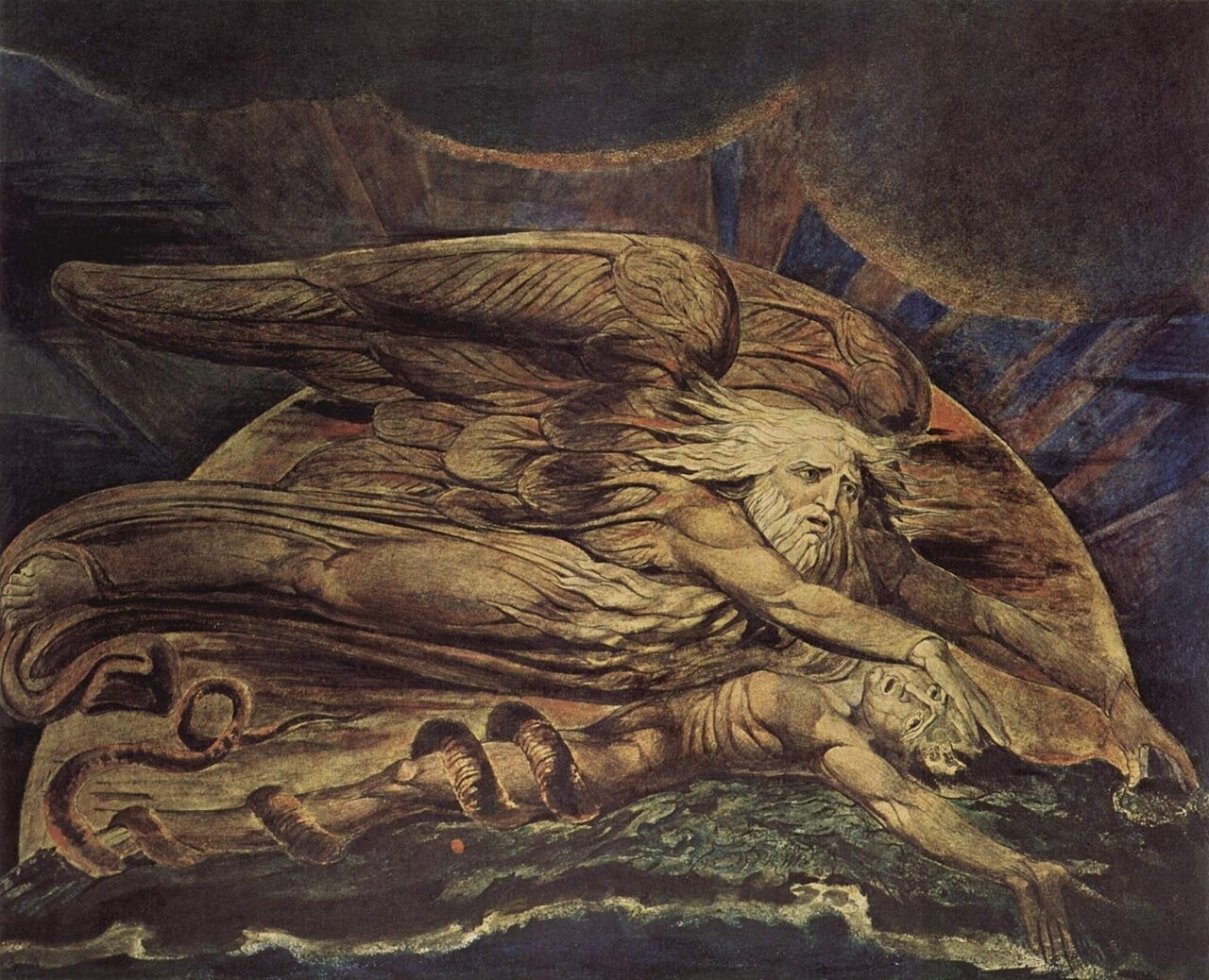
William Blake, Elohim Creating Adam, 1795, Tate, London. The Creator bends over Adam as he is shaped from the earth; for Blake the making of the body was also a binding of the spirit, and he painted it without sentiment.
Jean-Auguste-Dominique Ingres, The Apotheosis of Homer, 1827, Louvre. The poet crowned and enthroned among the makers of later ages; see On Apotheosis.
The Muses Sarcophagus, Rome, second century AD, Louvre. The nine Muses, each with her attribute.
Plato’s Academy, mosaic from Pompeii, first century BC. Philosophers in conversation; see The Golden Chain.
Buildings
The Pantheon, Rome, c. AD 125. A temple to the gods, a church since 609, and in worship ever since; see On the Nature of Temples.
Siena Cathedral, thirteenth and fourteenth centuries. Held by the Order in particular regard for the patron set into its pavement.
Saint-Denis, near Paris, 1140–44, and Chartres Cathedral, rebuilt after 1194. Light and stone raised by nameless makers; see The Cathedral Builders.
Hagia Sophia, Constantinople, 537. A single great space where generations of different faiths have brought their devotion; see In the Sanctuaries of Others.
Music
Hildegard of Bingen, Ordo Virtutum, c. 1151. A sung drama of the soul among the Virtues.
Johann Sebastian Bach, The Art of Fugue, left unfinished at his death in 1750. Craft carried to its furthest limit.
Joseph Haydn, The Creation, 1798. The oratorio of the making of the world, with its blaze of sound at “and there was light.”