Dante Alighieri
The Divine Comedy
“the Love that moves the sun and the other stars.”
Dante, Paradiso XXXIII.145, the last line of the Comedy
Dante Alighieri was a Florentine poet whose Divine Comedy, a journey through Hell, Purgatory and Paradise, is one of the supreme works of world literature.
Dante was born in Florence around 1265. His love for Beatrice Portinari, whom he met as a boy and who died young, became the inspiration of his early Vita Nuova and of his great poem. Active in the city’s bitter politics, he was exiled in 1302 and never returned; he wrote the Comedy in exile and died at Ravenna in 1321.
Guided first by the poet Virgil and then by Beatrice, the pilgrim Dante descends through the circles of Hell, climbs the mountain of Purgatory and rises through the heavens to the vision of God. The poem gathers theology, philosophy, history and the whole cosmos of medieval learning into a single ordered vision, written not in Latin but in the Tuscan vernacular, which it did much to make the language of Italy.
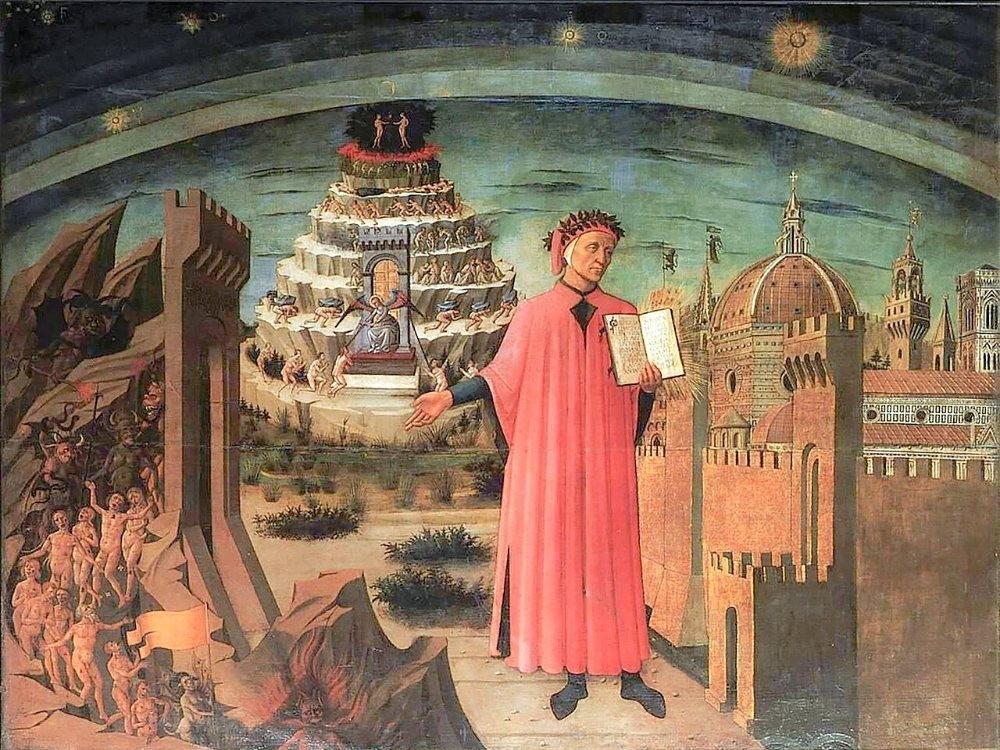
In 1465, a century and a half after his death, the city that had banished him commissioned the painting shown here for its cathedral. The Order honours the Comedy as perhaps the greatest attempt of any poet to give form to the sacred order of the universe.