On Inspiration
Whether a work is received or made
“Tell me, Muse, of the man of many turns.”
Homer, Odyssey I.1, translated from the Greek
Before a work is made, it must first arrive. Where it comes from is among the oldest questions makers have asked, and the Order keeps it open with care.
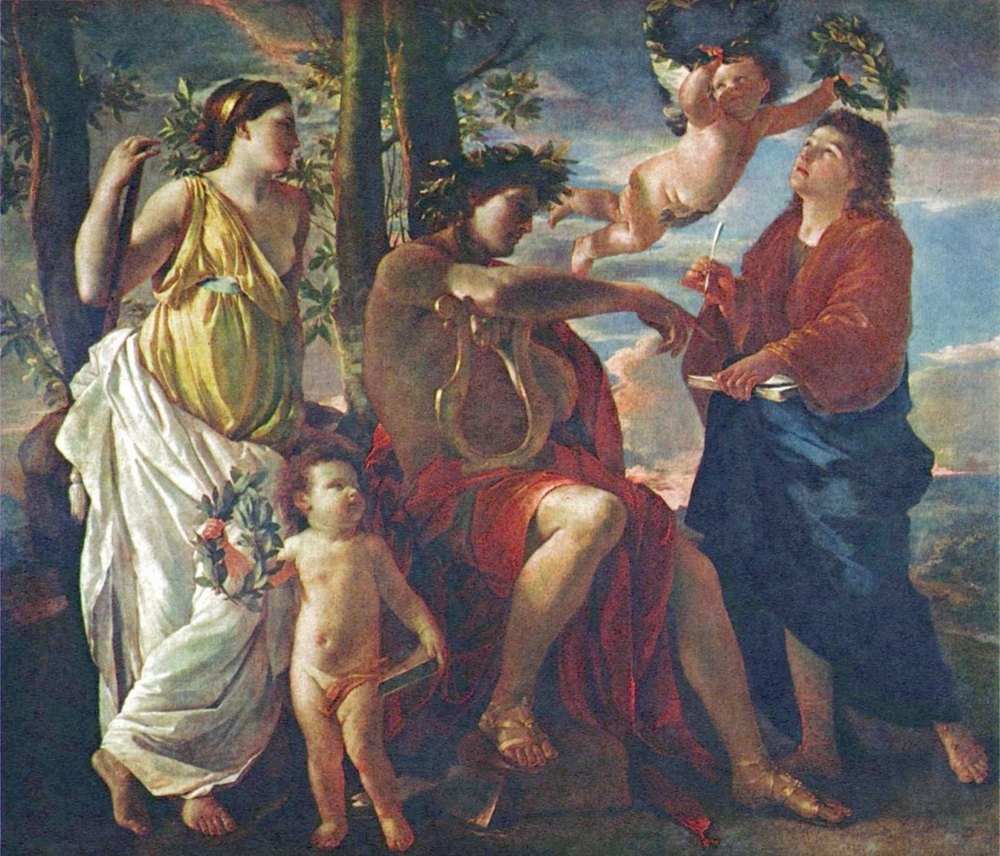
The earliest poets of Greece began by calling on the Muses, the nine daughters of Zeus and Memory. Hesiod tells how they came to him while he tended lambs beneath Mount Helicon, handed him a staff of laurel and breathed into him a divine voice. The word inspiration keeps the image: the Latin inspirare means to breathe into.
Plato took the idea seriously and a little uneasily. In the Ion he calls the poet a light and winged and holy thing, unable to compose until the god has entered him and his own mind has left him; in the Phaedrus he writes that whoever comes to the doors of poetry without the madness of the Muses, trusting to skill alone, will find his work eclipsed by the work of the inspired.
The Hebrew scriptures give the gift to a craftsman. In the book of Exodus the first person said to be filled with the spirit of God is Bezalel, the maker of the tabernacle, filled “in wisdom, and in understanding, and in knowledge, and in all manner of workmanship.” Centuries later Hildegard of Bingen described her visions as seen and heard, not devised.
Later makers gave both accounts. William Blake wrote that he composed a long poem “from immediate Dictation,” twelve or sometimes twenty or thirty lines at a time, without premeditation and even against his will. Edgar Allan Poe claimed the opposite for The Raven, which he said had proceeded step by step to its completion with the precision and rigid consequence of a mathematical problem. The truth of most works lies somewhere between.
The Order holds the two together. There is the idea that arrives unbidden, and there is the labour that gives it form, as in the Egyptian teaching of Ptah, where the heart conceives and the tongue brings forth. Whether what arrives comes from the Supreme Divine, from the depths of the mind as Jung believed, or from a life’s gathered experience is left to individual conviction. See also Coleridge on the Imagination.
It is fitting that the ancients made the Muses daughters of Memory. Whatever else inspiration may be, it draws on all that a maker has received, and so what is preserved feeds what is yet to be made. The Order asks that what arrives be received with gratitude and given form with care; see the First and Second Breath.