The Poetic Genius
The faculty through which the divine is received
“The Religions of all Nations are derived from each Nation’s different reception of the Poetic Genius, which is every where call’d the Spirit of Prophecy.”
William Blake, All Religions are One, Principle 5th
The Order holds that every people has received the divine through one universal faculty, and given it form in its own stories, images and sanctuaries. After William Blake, it calls that faculty the Poetic Genius.
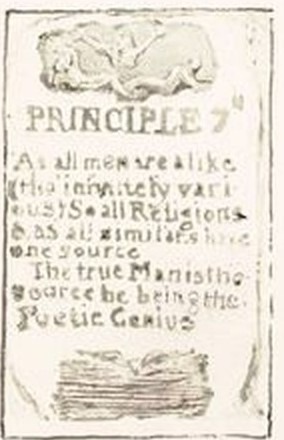
Around 1788, in one of his first experiments with relief etching, Blake made a small series of plates titled All Religions are One. In a handful of Principles he argued that all people are alike in the Poetic Genius as they are alike in outward form, and that the religions of every nation derive from each nation’s different reception of it. Nearly forty years later, in the Laocoön, he went further still, and wrote that the imagination is God himself.
The Order affirms the Poetic Genius as universal. It is the faculty through which humanity receives the divine and gives it form: in the gods of Egypt and the Muses of Greece, in the hymns of the Rigveda and the dance of Shiva, in the parables of the Gospels, in the visions of Hildegard and the poems of Ibn Arabi, in temples, icons and rites without number. This is why the Order can honour the sacred story of every tradition without claiming any as its own; see On the Nature of Temples. The Poetic Genius is the sacred faculty at its highest work, shaping humanity’s understanding of the divine itself.
Where the Poetic Genius comes from is left to individual conviction. For Blake it was the divine in person. A believer may understand it as the channel through which the Supreme Divine makes itself known, as Blake’s own phrase, the Spirit of Prophecy, suggests. Others may find its source in the depths of the human mind, as Jung did in the collective unconscious and its archetypes, or as Joseph Campbell did in the one story he heard beneath the myths of the world; others again in a universe that has brought forth minds able to dream of gods.
So the Order holds that every human idea of the divine has come through the one Poetic Genius, from one source, while each faith names that source in its own way. To a Christian it is the God of the Gospels, to a Muslim it is Allah; to others it is a power known only through the stories already told, or something in the depths of consciousness itself. The Order honours each faith in its own terms, and the God worshipped in any sanctuary as the Supreme Divine is honoured there as such; see In the Sanctuaries of Others.
On any of these accounts the Poetic Genius receives and gives form. It is the meeting place of the divine and the human, the point at which what is sought becomes what can be seen, told and shared. The Order asks that it be recognised in every tradition, one’s own included, and honoured wherever it has worked; see also On the Making of Gods and On Inspiration. An old Buddhist image suits the Order’s vision well: the net of the god Indra, with a jewel at every knot, each jewel reflecting all the others, and every reflection reflecting them again without end.