The Supreme Divine
On the ultimate source
The Order uses the phrase the Supreme Divine for the ultimate reality or power that may or may not lie behind all existence.
The Supreme Divine may be understood in many ways: as a personal God, as an impersonal creative principle, as the universe itself, or as something beyond the reach of human understanding. Whether it exists at all may likewise remain an open question. The Order leaves such matters to individual conviction. One of the oldest hymns in the world ends in the same humility: its creator “verily knows it, or perhaps he knows not”; see The Hymn of Creation. In the fifteenth century Nicholas of Cusa taught that the infinite lies beyond the grasp of any finite mind, which may draw ever nearer to it, as a many-sided figure draws nearer to a circle, but never reach it.
It distinguishes the Supreme Divine from the faculty it holds sacred: humanity’s capacity to create art, knowledge, stories, symbols, traditions and meaning. The faculty may be regarded as a gift of the Creator, as it was by Tolkien and Hildegard, or as a capacity arising from the universe, and no less wonderful for that. The Order’s ideals rest on the faculty, and stand whichever account is held. Whatever its source, the Order affirms the faculty through which humanity receives the divine and gives it form, which it calls, after Blake, the Poetic Genius.
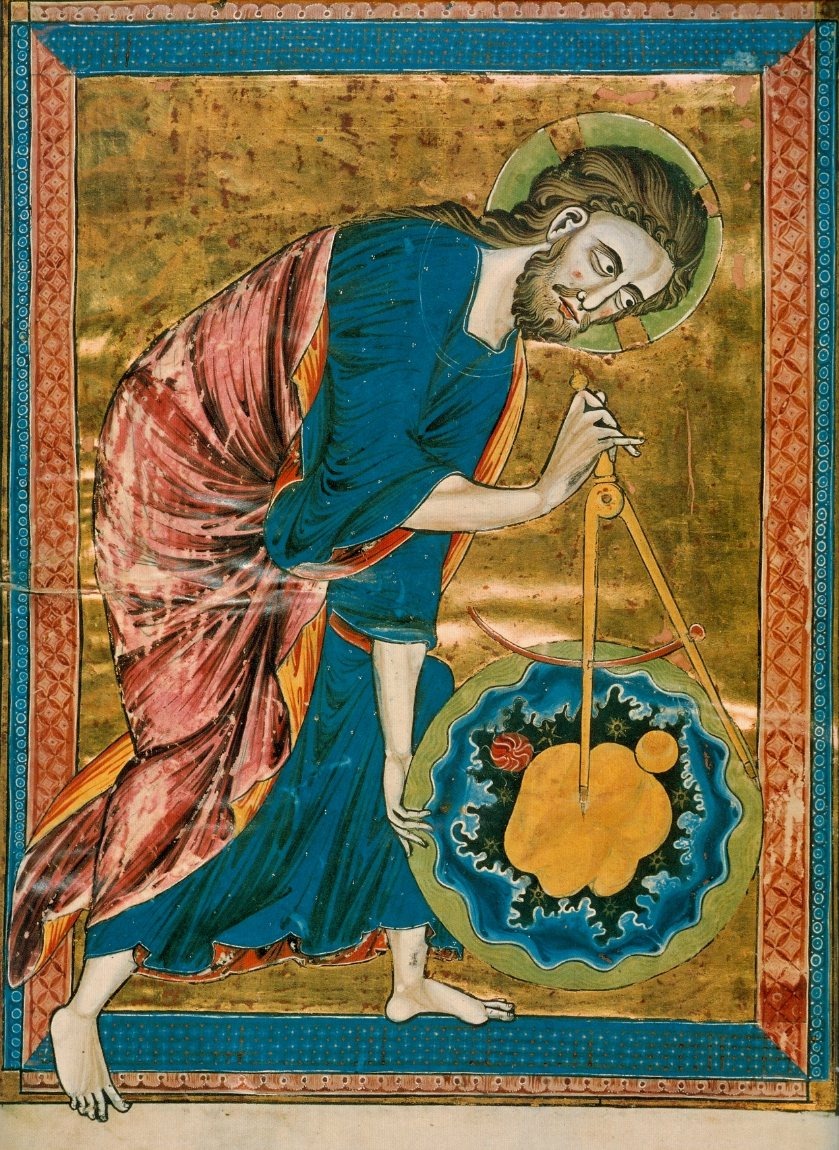
The medieval image of God the Geometer, bending over the world with a compass, joins the two ideas in a single picture: the ultimate Maker shown at the work of making. Artists and philosophers have returned to the image for centuries, Blake among them. The Order keeps it as a reminder that the question of the first Maker and the practice of making have always been close companions.
See also On the Nature of Temples and The Sacred Faculty.