The Hymn of Creation
Rigveda X.129
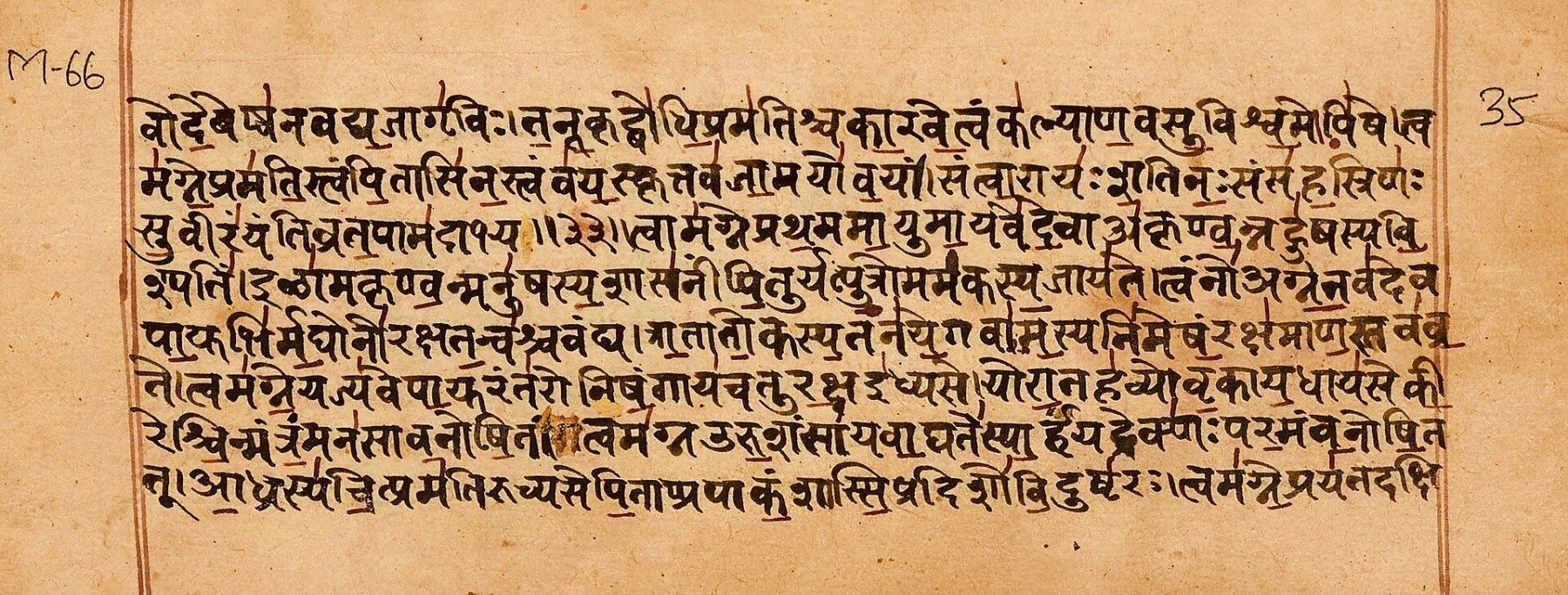
“He, the first origin of this creation, whether he formed it all or did not form it, whose eye controls this world in highest heaven, he verily knows it, or perhaps he knows not.”
Rigveda X.129.7, trans. Ralph T. H. Griffith, 1896
The Hymn of Creation, known from its opening words as the Nasadiya, is a short hymn in the tenth book of the Rigveda, among the oldest sacred texts in the world. It tells of the beginning of all things, and ends by asking whether anyone knows how they came to be.
The Rigveda is a collection of more than a thousand hymns in an early form of Sanskrit, composed in north-western India over many centuries and handed down by memory alone for a very long time. It was recited with such care that its words are thought to have changed very little. Its tenth and latest book contains several hymns on the making of the world.
The Hymn of Creation begins before the beginning. Then there was neither being nor non-being, neither air nor sky beyond it, neither death nor deathlessness, and no sign of night or day. That One breathed, without breath, by its own nature. Darkness lay hidden in darkness. Then, by the power of warmth, the One came into being, and in it arose desire, “the primal seed and germ of Spirit.” Sages searching with their hearts found the bond of being in non-being.
Then the hymn turns to doubt. Who truly knows, it asks, and who can declare it, whence this creation came? The gods themselves came later. He who first gave it form, if he formed it at all, who watches over it from the highest heaven, perhaps he knows; or perhaps he does not know.
Few sacred texts end in a question. The Order holds this one in particular regard for three reasons. It places the first stirring of creation in desire, as the Poimandres places it in the first human’s wish to make. It finds the kinship of being and non-being in the searching heart, where Ptah conceived the world. And it leaves the ultimate source open, as the Order does when it speaks of the Supreme Divine: the source that may or may not lie behind all that is, and that perhaps no one knows.