The Popol Vuh
The Maya book of creation
The Popol Vuh, the “Book of the Community,” is the sacred narrative of the K’iche’ Maya of the Guatemalan highlands. Its account of creation tells of gods who made the world, and then tried again and again to make beings who could speak of it.
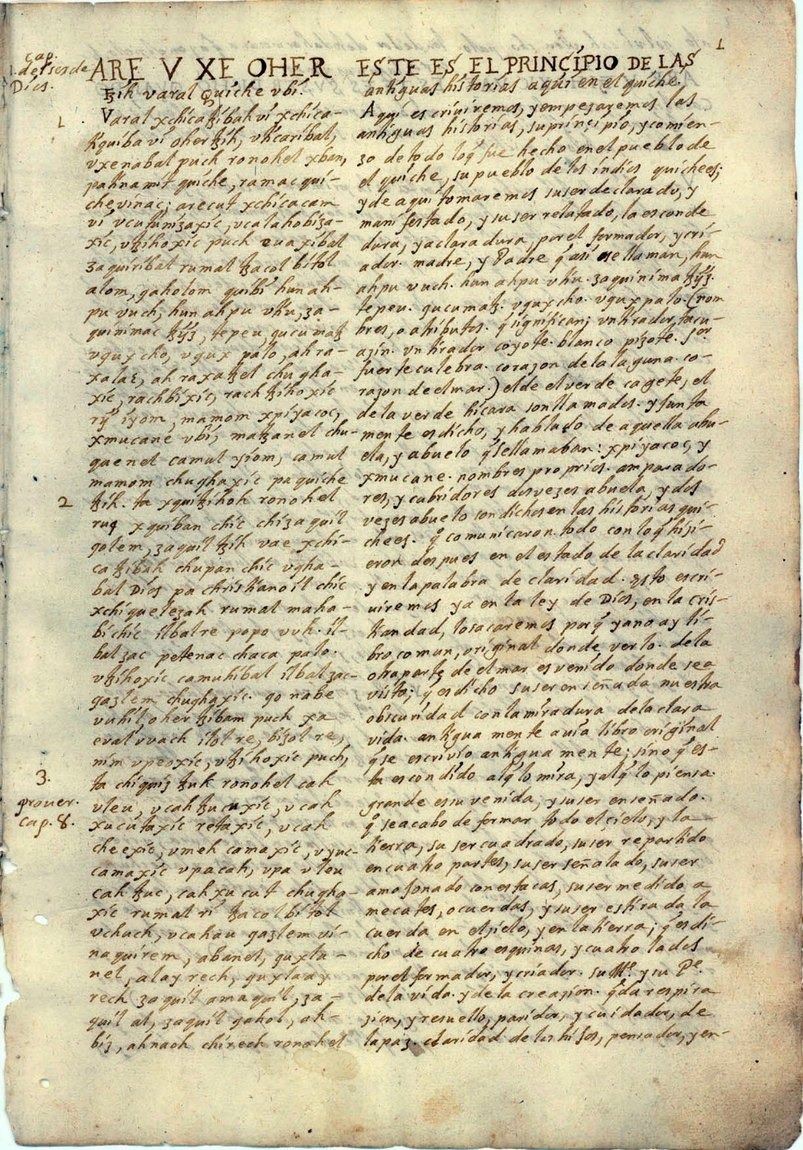
The stories it contains are far older than the book. Around 1550, after the Spanish conquest, K’iche’ nobles wrote them down in their own language in the Latin alphabet, so that they would not be lost. That manuscript has disappeared. What survives is a copy made around 1701 by the Dominican friar Francisco Ximénez in the town of Chichicastenango, with a Spanish translation beside it. It is now in the Newberry Library in Chicago.
In the beginning, the book says, there was only the calm sea and the empty sky. The makers, among them the Sovereign Plumed Serpent and Heart of Sky, spoke together, and they said “Earth,” and the earth arose. Then they made the animals, and asked them to speak their makers’ names. The animals could only squawk and howl, and so were given the forests and the ravines to live in.
Three times the makers tried to shape people. The first, of mud, crumbled and could not think. The second, of wood, could speak, but had no hearts and did not remember who had made them, and they were destroyed; their descendants, it is said, are the monkeys of the forest. At last the grandmother Xmucane ground yellow and white maize, and from its dough the first true people were made. They spoke, they understood, and they gave thanks. Their sight was so perfect that it reached across the whole world, and the gods, uneasy, clouded their eyes as breath clouds a mirror, so that they saw only what was near.
The Order holds the Popol Vuh apart among the creation stories of the world. Its makers want what the Order believes the world acquires in conscious minds: beings who can speak of it, remember and give thanks, so that it comes to mean something; see The Sacred Faculty. Like Ptah and Speech in India, its gods create by the word; and the mist upon the mirror is a humbling image of how much of the world lies beyond what any mind can see; see Ptah and the Spoken Word and The Hymn of Creation.