
Those Who Preserve
The keepers of the inheritance
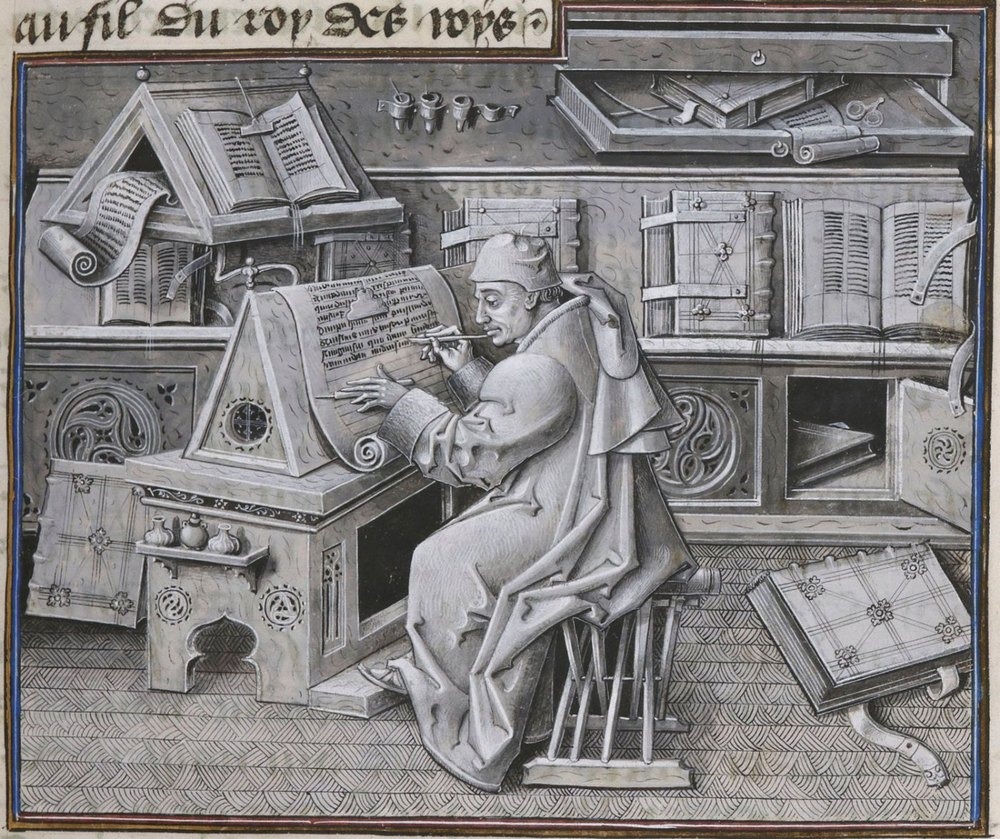
“And some there be, which have no memorial; who are perished, as though they had never been.”
Ecclesiasticus 44:9, King James Version
The Order’s motto sets preservation beside creation, because nothing that is made survives by itself. Every work that reaches us has passed through many hands, and most of those hands are nameless.
Much of the literature of antiquity survives only because it was copied. Around 554 the Roman statesman Cassiodorus founded the monastery of Vivarium in southern Italy and set its monks to copying both Christian and classical books. In the age of Charlemagne scribes copied the Latin classics in the clear new script now called Carolingian minuscule, and for many Roman authors the oldest surviving manuscripts date from that time.
Sometimes the keeping is the work of accident. When Nineveh fell in 612 BC, fire swept the palace of the Assyrian king Ashurbanipal and baked hard the clay tablets of his library, among them the Epic of Gilgamesh, which lay buried until the nineteenth century.
In Baghdad, from the eighth century to the tenth, scholars under the Abbasid caliphs translated Greek philosophy, medicine and science into Arabic, among them Hunayn ibn Ishaq and his circle. Much of that learning later passed into Latin through translators at Toledo and elsewhere, and returned to a Europe that had lost it.
The humanists of the Renaissance went looking for what had been forgotten. In 1417 Poggio Bracciolini found in a German monastery a manuscript of Lucretius’s poem On the Nature of Things, a work all but lost for a thousand years, and the libraries gathered by Cosimo de’ Medici and his circle kept what such searches recovered.
In 1900 a Taoist monk clearing sand from the cave temples of Dunhuang, on the Silk Road in western China, broke into a small chamber sealed around the year 1000 and packed with tens of thousands of manuscripts in many languages. Among them was a copy of the Diamond Sutra printed in 868, the oldest printed book that bears a date. Like the jar at Nag Hammadi, the cave kept what its makers could not have known would ever be read again.
The work continues. When the Arno flooded Florence in November 1966, volunteers from many countries, remembered as the angels of the mud, pulled books and paintings from the silt of the national library and the churches. In 2012 and 2013 the librarians of Timbuktu carried hundreds of thousands of manuscripts out of the city in secret to save them from destruction.
Some preserve what was never written down. Elias Lönnrot walked the villages of Karelia gathering the songs of rune singers into the Kalevala, and on the Order’s Roll of Honour stand Alan Lomax and Zora Neale Hurston, who recorded the voices of people the written record had passed over.
Some traditions keep their inheritance in another way. Tibetan monks spend days laying out a mandala in coloured sand, grain by grain, and then sweep it away and pour the sand into running water. What is kept there is not the object but the knowledge and devotion that made it, handed from teacher to pupil to be made again.
The Order counts preservation as creative work of its own. To copy, translate, restore or record is to decide what the future will be able to know. The Hermetic writings teach that nothing in the world perishes; what minds have made perishes all too easily, unless someone keeps it; see Nothing Perishes and The Art of Memory. It honours the keepers of the inheritance as it honours its makers, and remembers the nameless among them most of all; see To Create, To Preserve, To Uphold, Temples of Knowledge and the Serapeum.