Cassiodorus
The founder of Vivarium
“He preaches to people with his hand, and unlooses tongues with his fingers.”
Cassiodorus on the scribe, Institutions I.30, paraphrased from the Latin
Cassiodorus was a Roman statesman who, at the end of a long public life, founded the monastery of Vivarium and made the copying of books a sacred labour.
He was born around 485 into a noble family at Scylletium, the modern Squillace, in Calabria. Under the Ostrogothic king Theodoric and his successors he rose to the highest offices of the Italian state, and the official letters he wrote in their name, collected as the Variae, are among the chief sources for the history of the age.
The wars that followed brought that world to an end. Around 554 Cassiodorus retired to his family estate by the sea and founded a monastery there, named Vivarium after its fishponds. He gathered a library, and set his monks to copying, correcting and binding books, Christian and classical alike.
For them he wrote the Institutions, a guide to sacred and secular learning that became one of the foundations of monastic education. In it he praised the scribe above other labourers: every word copied, he wrote, is a sermon preached with the hand. He was still writing in his nineties, and is said to have lived to nearly a hundred.
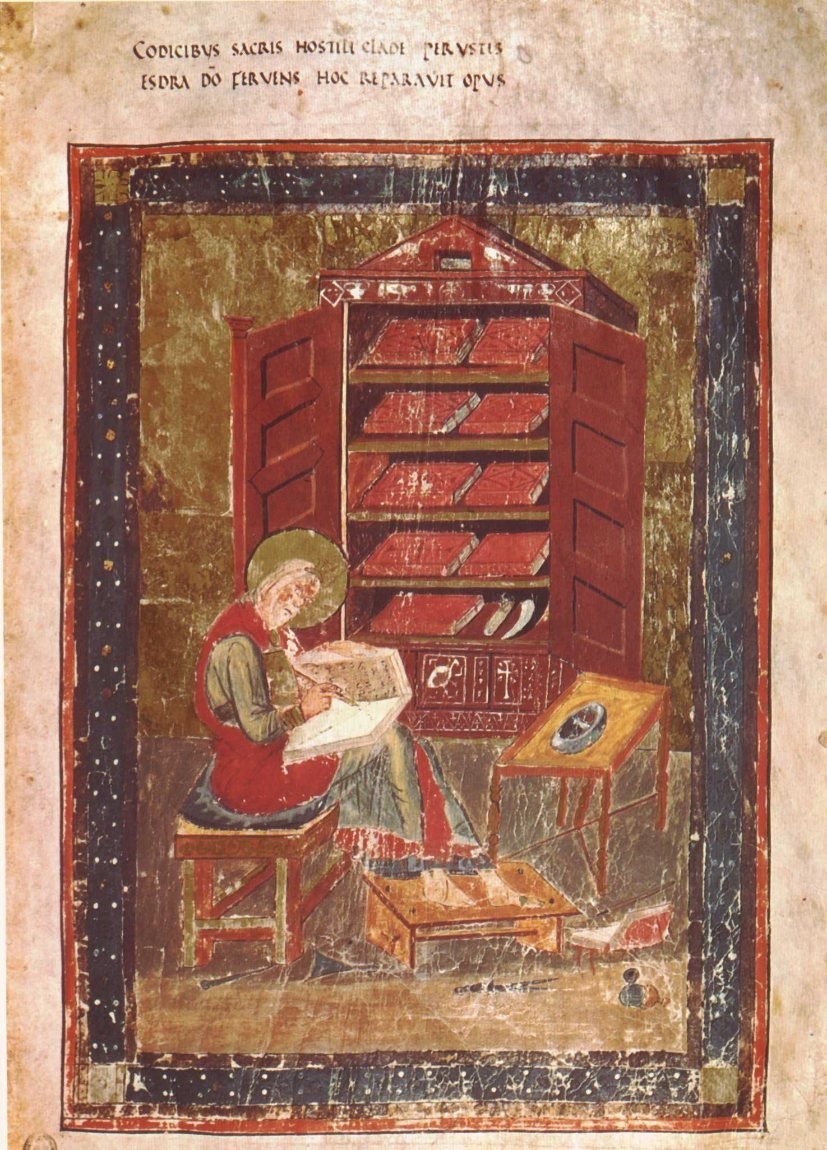
The library of Vivarium was dispersed after his death, but its books and its ideal travelled. A great Bible made for Cassiodorus seems to have reached Northumbria, where the monks of Wearmouth-Jarrow produced the Codex Amiatinus, whose portrait of the scribe Ezra is shown here.
In Cassiodorus the Order sees the example of every copyist: a man who understood that the preservation of the inheritance is a holy work; see Those Who Preserve.