
The Creation of Adam
The Sistine Chapel ceiling
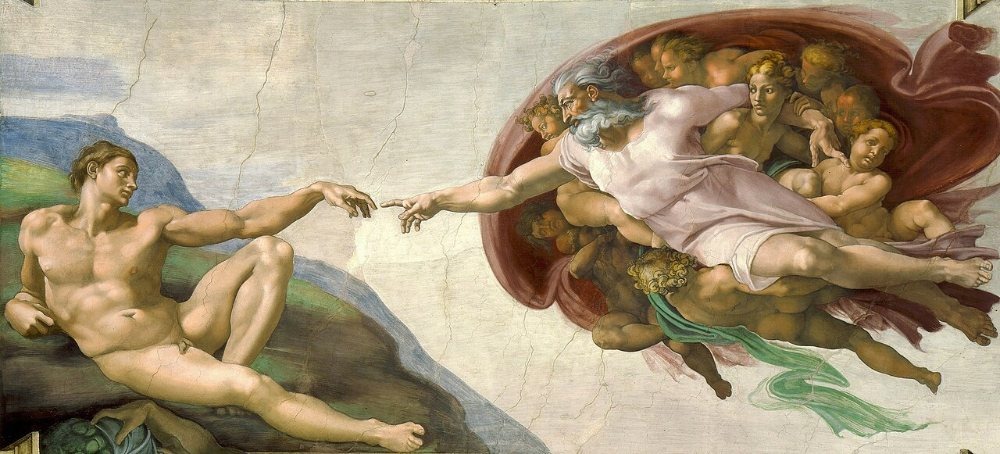
The Creation of Adam is a fresco by Michelangelo on the ceiling of the Sistine Chapel, and one of the most reproduced images in the history of art.
Pope Julius II commissioned the ceiling in 1508, and Michelangelo completed it in 1512. The Creation of Adam is one of nine scenes from the book of Genesis along the centre of the vault. Adam reclines on the bare earth, his body complete but languid. God, borne by a company of angels within a great billowing mantle, stretches out his arm, and the fingers of the two figures almost meet. The space between them has been discussed ever since.
In 1990 the physician Frank Lynn Meshberger proposed in the Journal of the American Medical Association that the mantle surrounding God closely resembles a sagittal section of the human brain, with recognisable anatomical features. Michelangelo is known to have studied anatomy through dissection. His intention is not recorded, and the reading remains an interpretation.
It is a reading the Order finds apt. The fresco shows the divine appearing within the form of a mind, reaching toward a human being who is about to receive life. A work, once made, may carry meanings further than its maker could follow, and this too is part of the life of works.
Read in this way, the fresco suggests that the image of the divine that humanity knows is itself formed in the human mind. God is painted from within a brain: whatever lies beyond it, the divine becomes present to us through the faculty that imagines it. It proposes that the meaning we meet in the universe comes to us through the mind, while leaving room for a power that precedes humanity; see The Supreme Divine. Whether the capacity to create meaning was placed in humanity by a creator or arose from the universe itself, it is through that capacity that meaning enters the world, and it is this capacity the Order holds as sacred.
Compare the account of the first human in the Hermetic Poimandres, and the words of Pico’s God to Adam.