
Giovanni Pico della Mirandola
The shaper of himself
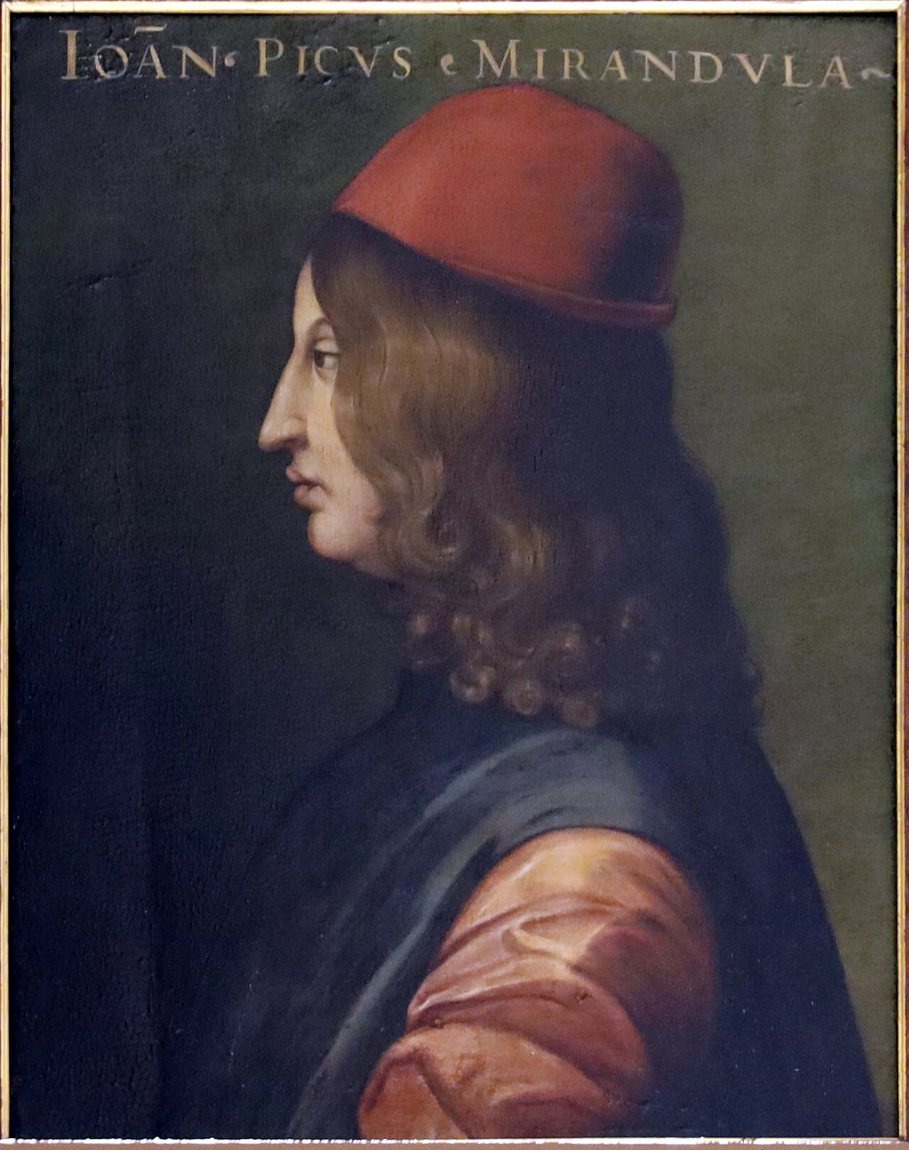
“We have given you, Adam, no fixed place, no form of your own, and no function peculiar to you… so that, as the free and honourable shaper and maker of yourself, you may fashion yourself in whatever form you prefer.”
Pico della Mirandola, Oration (1486), translated from the Latin
Giovanni Pico della Mirandola was an Italian philosopher whose Oration, written in 1486, became one of the most celebrated statements of Renaissance thought on human freedom and dignity.
Pico was born in 1463 into the family of the lords of Mirandola. He studied law and philosophy at Bologna, Ferrara, Padua and Paris, learned Greek, Hebrew and Arabic, and came to Florence, where he joined the circle of Marsilio Ficino and Lorenzo de’ Medici.
In 1486 he published nine hundred theses drawn from philosophy, theology, Kabbalah and the Hermetic writings, and invited scholars to debate them publicly in Rome. He composed an oration to open the debate. It never took place. Pope Innocent VIII suspended it, and a papal commission condemned thirteen of the theses. Pico fled to France, was briefly detained, and returned to Florence under Lorenzo’s protection. He died there on 17 November 1494, aged thirty-one. The oration was published after his death, and its familiar title, On the Dignity of Man, was added by later editors.
The oration begins with two witnesses to the wonder of humanity: a saying of “Abdala the Saracen” that nothing is more admirable than man, and the words of Hermes from the Asclepius: “A great miracle, Asclepius, is man.” Pico then imagines God speaking to Adam. Every other creature has been given a fixed nature. Humanity alone has been left undetermined, free to sink to the level of beasts or rise to the level of angels, as the maker of its own form.
The Order regards the oration as a Renaissance restatement of the Hermetic conviction it holds most dear. Pico’s Adam is a sculptor whose material is himself. For Pico this freedom was a gift of God; the Order leaves its source to individual conviction, but all may recognise the gift.