
Lorenzo de’ Medici
Il Magnifico
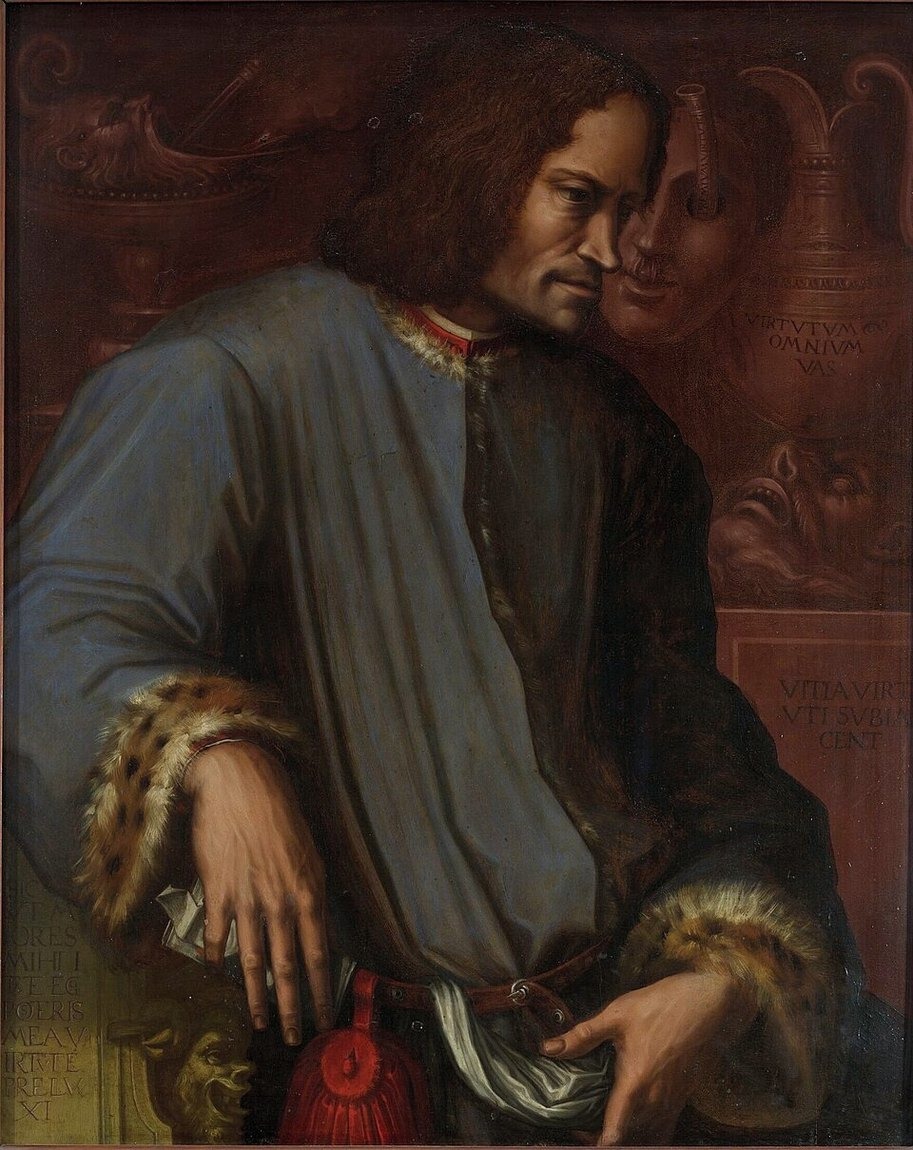
“How lovely is youth, and yet it flies away.”
Lorenzo de’ Medici, Song of Bacchus, translated from the Italian
Lorenzo de’ Medici, called the Magnificent, ruled Florence in the last decades of the fifteenth century. He was a poet in his own right, and the city’s Renaissance gathered around him.
He was born in 1449, the grandson of Cosimo de’ Medici, and grew up among scholars; Marsilio Ficino was among his teachers. At twenty he succeeded his father as head of the family and, without holding any formal office, of the Florentine state. In 1478 the Pazzi conspirators attacked him and his brother Giuliano during Mass in the cathedral. Giuliano was killed; Lorenzo, wounded, escaped, and ruled for fourteen years more.
He wrote in the Tuscan tongue at a time when many scholars still preferred Latin: sonnets, carnival songs and, most famously, the Song of Bacchus, whose refrain tells whoever would be happy to be so now, for there is no certainty of tomorrow. Around him gathered the poet Angelo Poliziano, the painter Sandro Botticelli, Pico della Mirandola and the circle of Ficino at Careggi.
His patronage reached from manuscripts to marble. He added greatly to the family’s collection of Greek and Latin books, which became the core of the Biblioteca Medicea Laurenziana, and a manuscript of Ficino’s translation of the Corpus Hermeticum was made for him. In the garden of San Marco he kept ancient sculptures where young artists could study, and there he noticed a boy of fifteen named Michelangelo, whom he took into his own household.
He died at the Medici villa of Careggi in April 1492, at forty-three, and two years later the Medici were driven from Florence. The Order remembers Lorenzo as a maker who also made room for others to make; see To Create, To Preserve, To Uphold.