The Corpus Hermeticum
The Greek Hermetic treatises
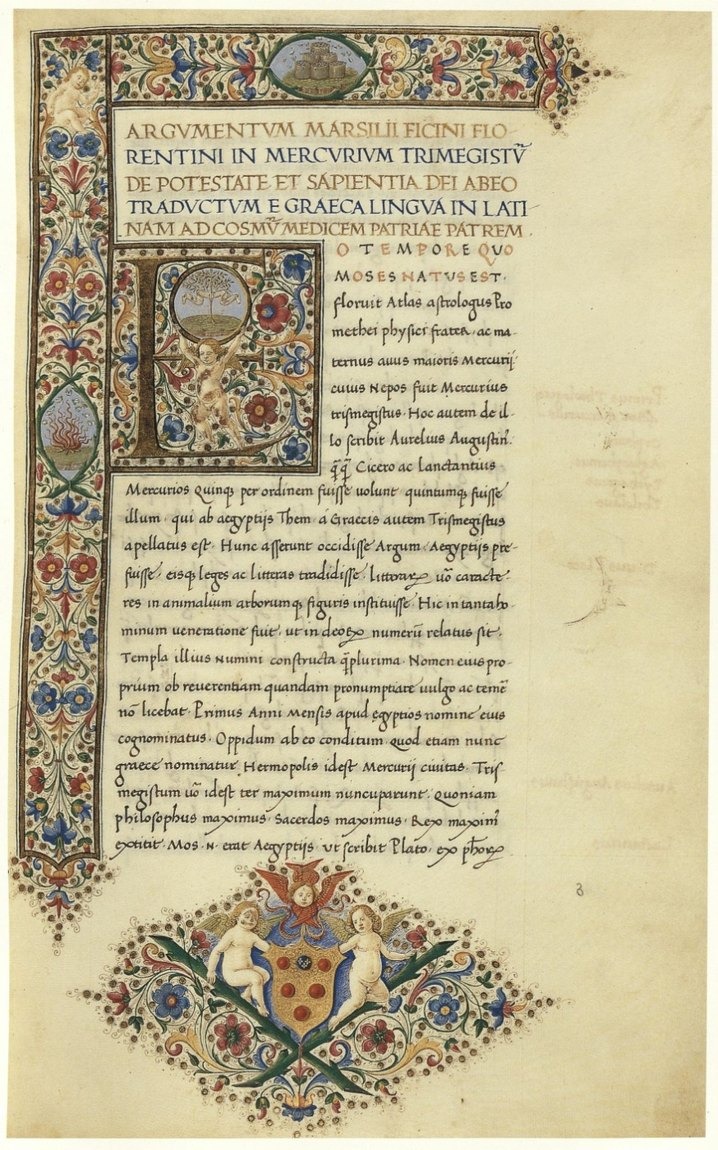
The Corpus Hermeticum is a collection of Greek philosophical and religious treatises attributed to Hermes Trismegistus, preserved in Byzantine manuscripts and first translated into Latin in Renaissance Florence.
The collection contains seventeen treatises, conventionally numbered from one to eighteen. The individual texts were written in Roman Egypt, probably between the first and third centuries AD, but the collection as we have it was assembled later, in the Byzantine world; it was known to the eleventh-century scholar Michael Psellos. The treatises vary in length and outlook, from the visionary Poimandres to short discourses on the mind, the good and the nature of the cosmos.
The eleventh treatise contains a passage of particular interest to the Order. Mind instructs Hermes that God cannot be understood by one who remains small: the soul must make itself as great as the whole of what it contemplates, leap beyond all body and time, and hold within itself at once the sea, the earth and the heavens, things past and things to come. The exercise it describes is, among other things, an exercise of the imagination.
In about 1460 a manuscript of the collection reached Florence, where Cosimo de’ Medici had it translated by Marsilio Ficino. Ficino finished treatises one to fourteen in 1463. His translation, titled after its first treatise, was printed at Treviso in 1471 and reprinted many times in the following century. For most Renaissance readers, this Latin Pimander simply was Hermes.
The Order counts the Corpus among the principal texts of its inheritance, together with the Asclepius. They reward a lifetime of rereading.