
Hermes Trismegistus
The Thrice-Great
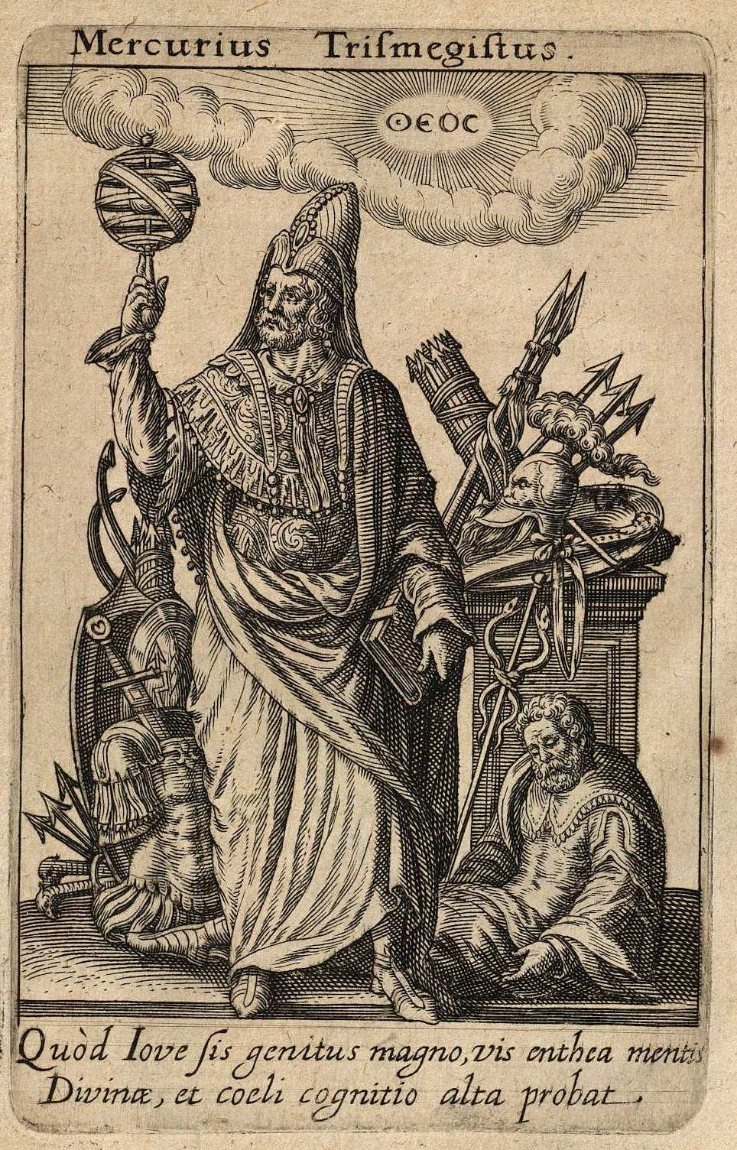
Hermes Trismegistus, “Thrice-Great Hermes,” is the legendary teacher to whom a large body of Greek, Latin, Coptic and later Arabic writings on the divine, the cosmos and the soul was attributed.
The figure developed in Ptolemaic and Roman Egypt from the identification of the Egyptian Thoth with the Greek Hermes. Ancient authors described him variously as a god, as a deified sage and as a human teacher of remote antiquity. Clement of Alexandria, writing around AD 200, reported that Egyptian priests carried forty-two books of Hermes in their processions, covering hymns, astronomy, temple ritual and medicine.
The surviving Hermetica fall broadly into two groups. The so-called technical writings concern astrology, alchemy and magic. The philosophical writings, which matter most to the Order, include the Greek treatises of the Corpus Hermeticum, the Latin Asclepius, a number of fragments preserved by later authors, and the Coptic texts discovered at Nag Hammadi. Most were probably composed between the first and third centuries AD, often in the form of dialogues between Hermes and his pupils Tat, Asclepius and Ammon.
Their themes recur: a single God beyond all things; the cosmos as the image of that God; the human being as a creature of two natures, mortal in body and divine in mind; and knowledge of God as the path by which the soul returns to its source. They are not the work of one author and do not form a single system, but they share a distinctive seriousness about the dignity of the human mind.
Hermes did not disappear with the ancient world. He was quoted by Christian writers, identified in Arabic tradition with the prophet Idris, and credited with the Emerald Tablet of the alchemists. In 1463 Marsilio Ficino translated the Corpus Hermeticum into Latin, and for a century and a half Europe honoured Hermes as one of the oldest theologians, until Isaac Casaubon placed the texts in the first centuries of the Christian era.
On the Order’s regard for him, see The Patronage of Hermes.