The Poimandres
The vision of creation
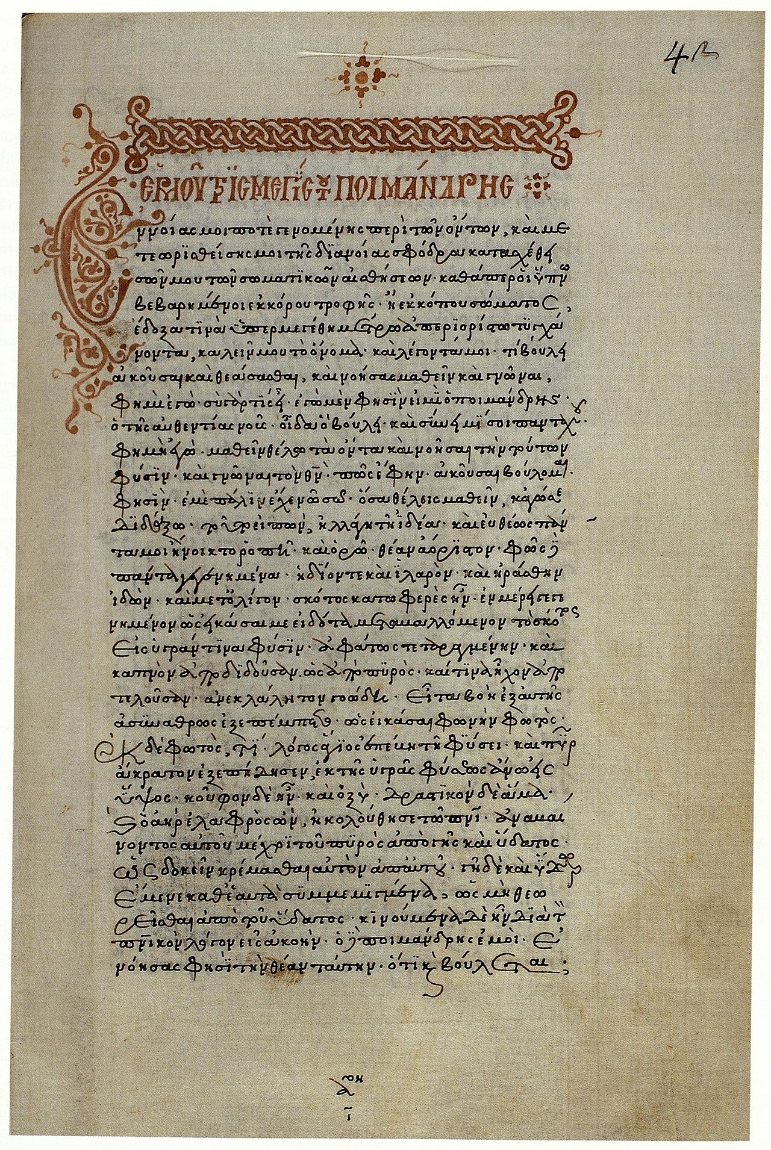
The Poimandres is the first treatise of the Corpus Hermeticum: an account of a vision in which the divine Mind reveals to its narrator the making of the world and of humanity.
The narrator, withdrawn in thought, is visited by a vast being who names himself Poimandres, the Mind of sovereignty. At his word the narrator sees an endless light, a darkness that becomes moist nature, and a holy Word that goes forth from the light. A second Mind, a divine craftsman, then fashions seven governors, the powers of the planets, who encircle the world.
Then the Father, who is Mind, brings forth the Human, beautiful and bearing the Father’s own image, and loves him as his own form. The Human beholds the craftsman’s creation and wishes to make something as well; the Father consents. Descending through the spheres, the Human leans down through the cosmic frame, sees his own form reflected in Nature, and embraces her. From this union comes humanity as it now is: mortal in body, immortal in its essential being.
The treatise ends with instruction on the ascent of the soul and with the narrator beginning to teach others. Its name was given by Ficino to his entire Latin translation, and through that translation it became the best known Hermetic text of the Renaissance.
The Order gives particular attention to one moment in the vision: the first human being, seeing a work well made, desires to make. In that desire the Order recognises the faculty it holds sacred, described in one of the oldest surviving accounts of it as part of humanity’s inheritance from the divine.