Ptah and the Spoken Word
Creation in the Memphite tradition
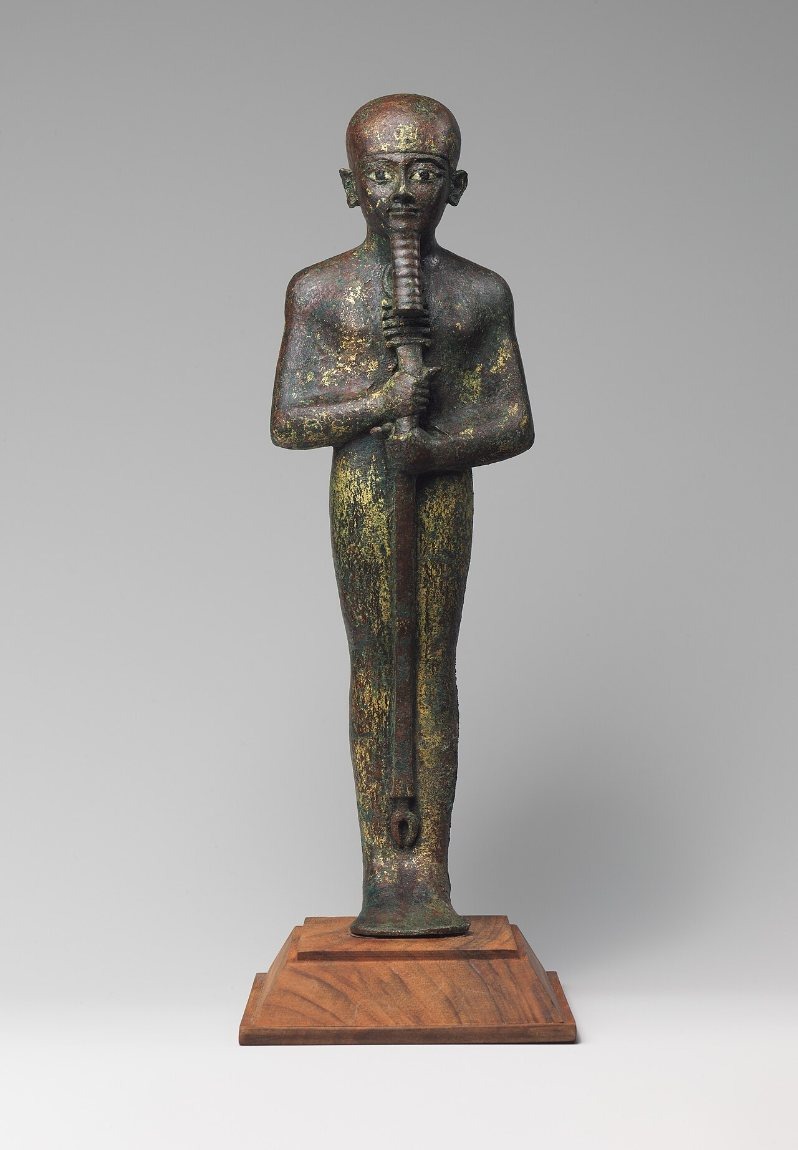
Ptah, the creator god of Memphis, is central to an Egyptian account in which creation proceeds from the heart and the spoken word.
Ptah was the principal god of Memphis, the ancient capital of Egypt, and the patron of craftsmen, sculptors and builders. He was usually shown as a man wrapped in a close-fitting garment, with a skullcap, holding a sceptre that combines the was, the djed and the Ankh. The Greeks later identified him with Hephaestus, the smith of the gods.
The chief witness to his theology of creation is the Shabaka Stone, inscribed around 710 BC. Its text, often called the Memphite Theology, describes the heart conceiving and the tongue expressing what the heart has conceived. By this means Ptah brings the gods, their cities and their images into existence, and gives form to all things. The date of the underlying composition is debated.
It is appropriate that the god of craftsmen should create in this way. The account follows the same sequence as the work of an artisan: a thing is first conceived, then declared, then given material form.
India preserves a kindred teaching. In a hymn of the Rigveda, Speech herself, the goddess Vac, declares that she moves with the gods and upholds them, and that she makes the one she loves a seer and a sage; later texts say that the creator brought forth the world through her. In Egypt and in India alike the word was felt to stand near the beginning of things; see The Hymn of Creation. The Jewish Book of Creation makes the world from the letters of the alphabet, and in the Maya Popol Vuh the gods say “Earth,” and the earth arises.
The Order values the Memphite account as one of the earliest surviving expressions of an idea it holds central: that creation begins as a conception of the mind and is completed in expression. It finds in the theology of Memphis an ancient recognition of the path from thought to made thing.