The Book of Creation
Sefer Yetzirah
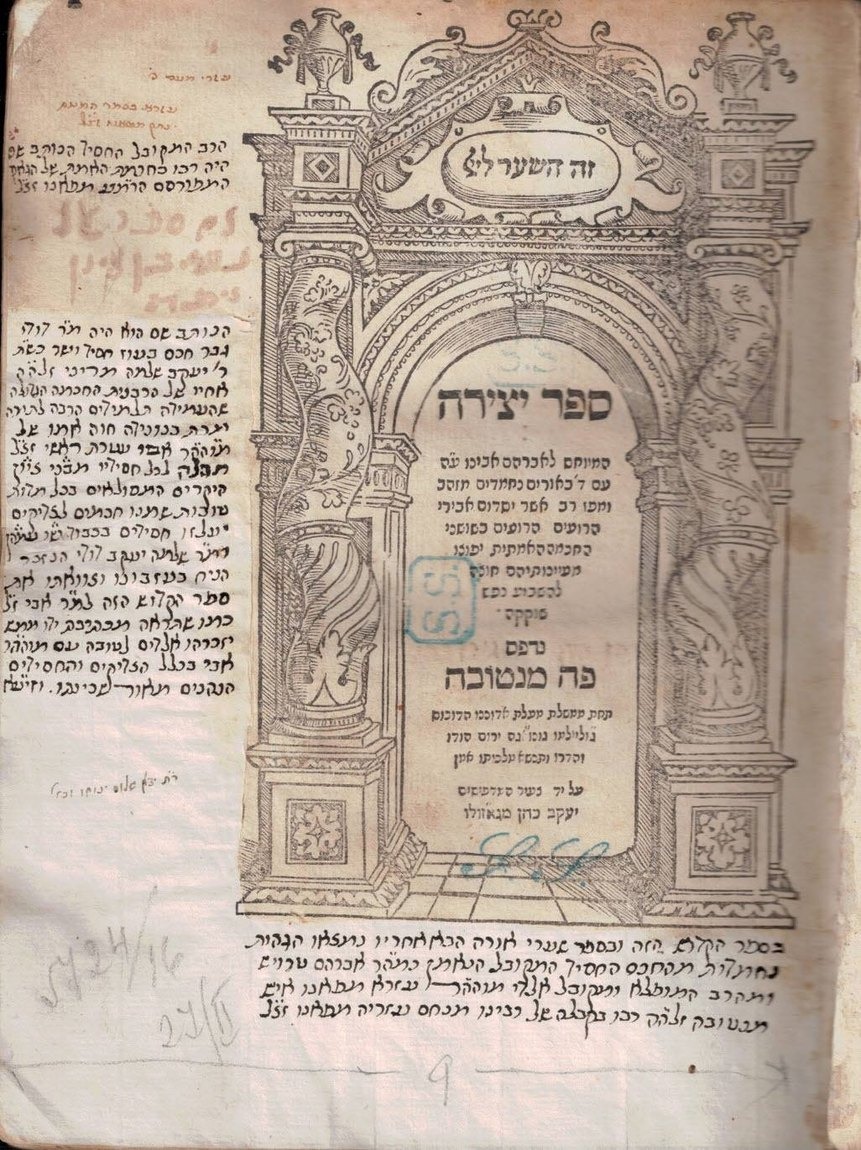
Sefer Yetzirah, the Book of Creation, is a short and ancient Hebrew text which teaches that God made the world through the letters of the alphabet. It is the oldest surviving work of Jewish speculation on creation, and one of the founding texts of the Kabbalah.
Its date and author are unknown. Tradition ascribed it to Abraham; scholars place its composition somewhere between the second and sixth centuries AD. It is only a few pages long, written in terse, riddling sentences, and it has drawn commentaries for more than a thousand years, beginning with that of the philosopher Saadia Gaon in 931.
It opens with thirty-two wondrous paths of wisdom by which God created the world: the ten sefirot, the primal numbers, and the twenty-two letters of the Hebrew alphabet. The letters are the true materials of creation. God engraved them, carved them, weighed them, combined and exchanged them, and formed from them all that is formed and all that ever will be formed.
The Talmud tells that two rabbis studied the laws of creation every Sabbath eve and made from them a calf, which they ate; and later legend made the Book of Creation the means by which a golem could be brought to life; see Works That Come Alive. In the Renaissance Pico della Mirandola studied the Kabbalah as a key to the mysteries, and a Latin translation was printed in Paris in 1552.
The Order reads the Book of Creation beside the Egyptian account of Ptah, who made the world by his word, and the Indian hymn to Speech. Its letters are the same letters with which every poet and scribe works: in this teaching, the materials of the divine maker and the human maker are one and the same. It is a fitting thought for an order whose patron descends from Thoth, the god of writing.