J. R. R. Tolkien
Sub-creation
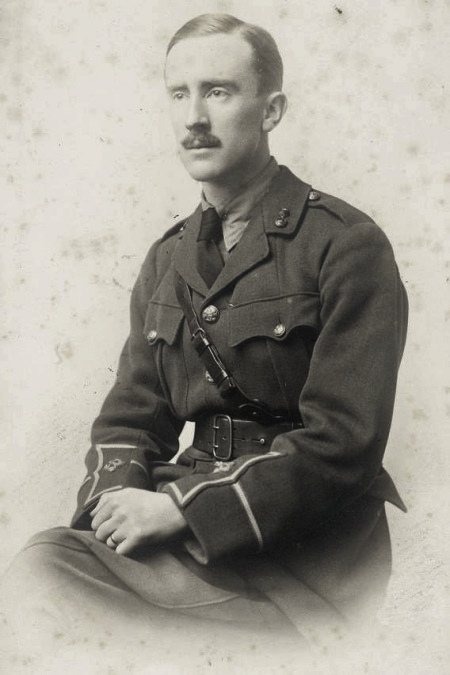
John Ronald Reuel Tolkien was an English philologist, scholar and writer whose invented world, with its languages, histories and myths, is among the largest works of the creative imagination ever undertaken by a single person.
Tolkien was born in 1892 in Bloemfontein, in southern Africa, and grew up in and around Birmingham. After serving as a signals officer on the Somme in 1916, he became a scholar of Old and Middle English, and held professorships at Oxford from 1925 until his retirement. His lecture on Beowulf, published in 1936, changed how the poem is read.
His literary work grew out of his love of language. He began inventing languages as a boy, and his Elvish tongues, Quenya and Sindarin, came to need a world and a history in which they could have been spoken. From that need came the legends later published as The Silmarillion, and from them The Hobbit (1937) and The Lord of the Rings (1954–55).
In his essay “On Fairy-Stories,” first given as a lecture in 1939, Tolkien set out a theory of what he called sub-creation. The maker of a story, he argued, creates a Secondary World which the mind can enter, and within which things are true according to its own laws. A devout Catholic, he understood this power as a gift of the Creator: human beings make because they are made in the image of a Maker.
The Order regards Tolkien’s account of sub-creation as one of the clearest modern statements of the faculty it holds sacred. It is closely related to what the Order calls the Second Breath.