
William Morris
The dignity of the hand
“Have nothing in your houses that you do not know to be useful, or believe to be beautiful.”
William Morris, “The Beauty of Life,” lecture, 1880
William Morris was an English designer, craftsman, poet, translator and preservationist, and the leading spirit of the Arts and Crafts movement.
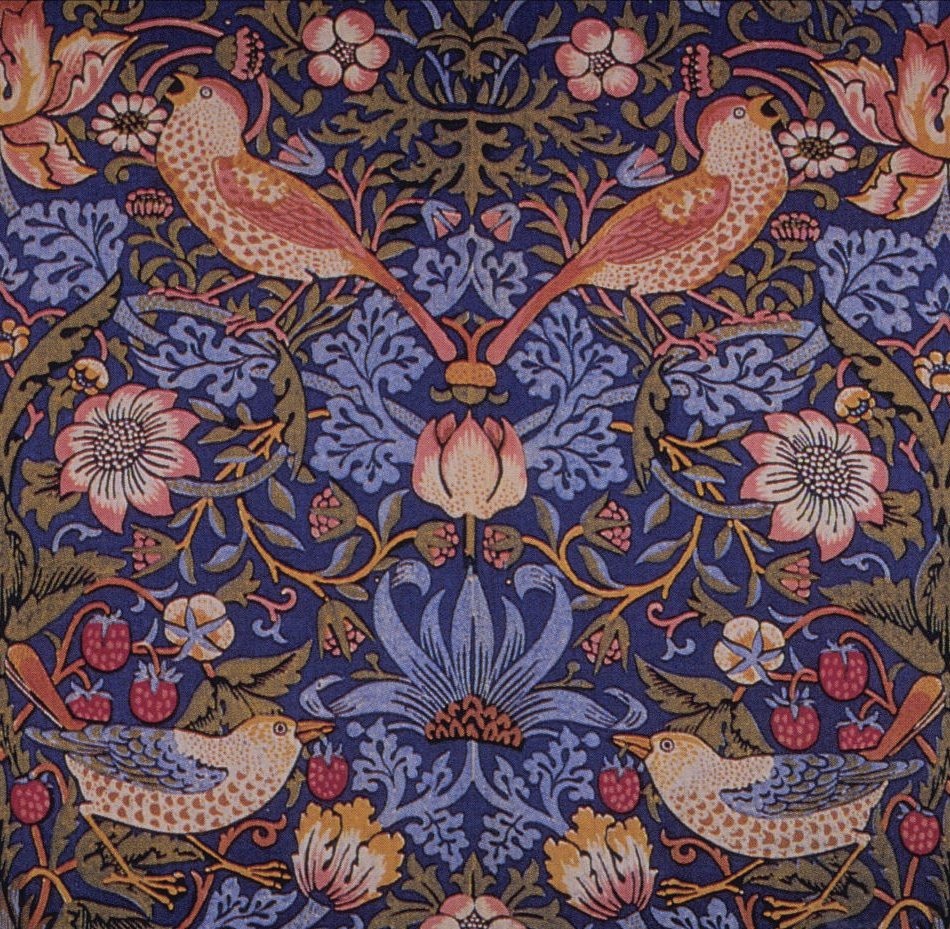
Morris studied at Oxford, where he formed a lifelong friendship with the painter Edward Burne-Jones. In 1861 he founded, with friends, the firm later known as Morris & Co., which produced wallpapers, textiles, stained glass, tapestry and furniture. He taught himself many of the crafts it practised, including the old methods of vegetable dyeing; Strawberry Thief, designed in 1883, was printed at his Merton Abbey works by the laborious indigo-discharge process.
He was equally prolific as a writer. His long poem The Earthly Paradise retold tales from classical and northern myth, and after journeys to Iceland in 1871 and 1873 he translated sagas with the scholar Eiríkr Magnússon. His late prose romances, set in invented worlds, are among the ancestors of modern fantasy.
In 1877 Morris founded the Society for the Protection of Ancient Buildings, to defend old churches and houses from destructive restoration, and in 1891 he established the Kelmscott Press, whose Chaucer of 1896 is one of the most beautiful books ever printed.
Morris held that work done by the hand, with thought and pleasure, is itself a source of beauty and of human dignity. In him the Order sees all three of its duties at once: he created, he preserved, and he laboured to uphold the worth of those who make.