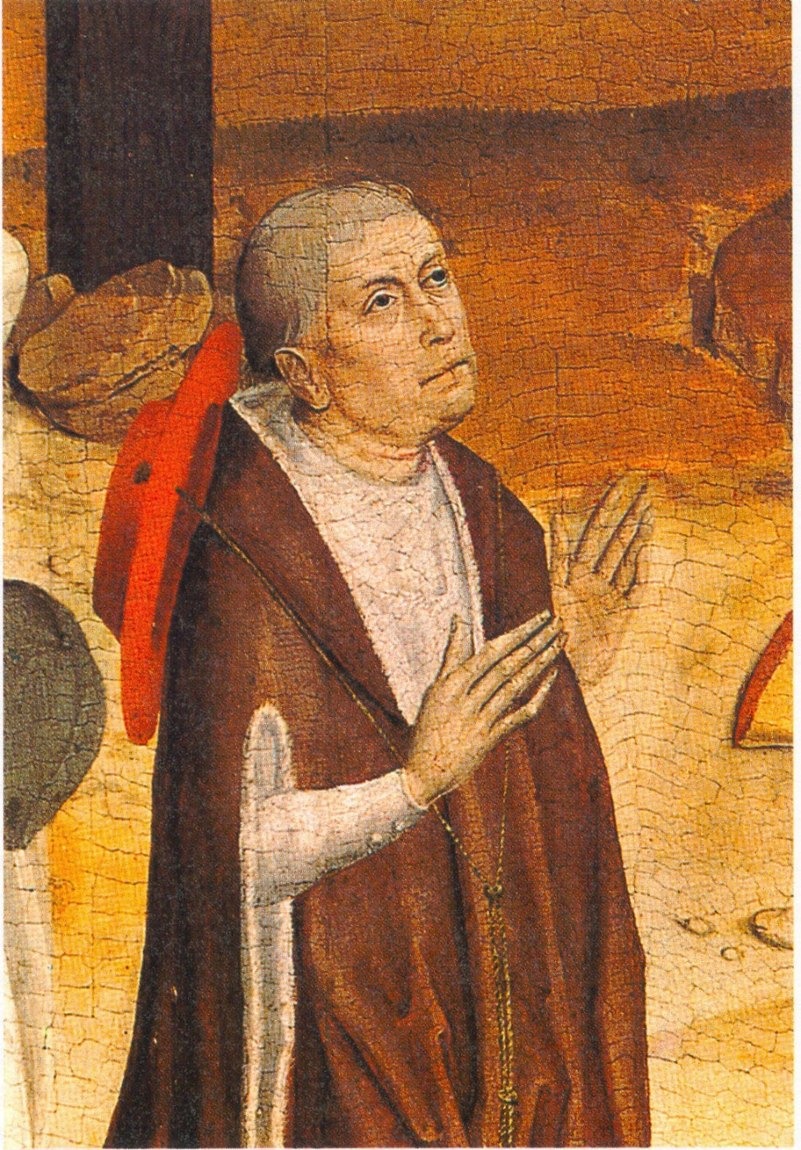
Nicholas of Cusa
Learned ignorance and the human god
“Just as God is the creator of real beings and natural forms, so the human being is the creator of conceptual beings and artificial forms.”
Nicholas of Cusa, De beryllo, 1458, translated from the Latin
Nicholas of Cusa was a German cardinal, churchman and philosopher, one of the boldest minds of the fifteenth century, who taught that the infinite lies beyond all knowing and that the human mind is itself a maker of worlds.
He was born in 1401 at Kues on the Moselle, the son of a prosperous boatman, and studied at Heidelberg, Padua and Cologne. He was a searcher of old libraries as well as a lawyer, and in 1429 he brought to Rome a manuscript containing twelve comedies of Plautus that had been lost for centuries. In 1437 he sailed to Constantinople with the embassy that brought the Greek emperor and patriarch to the council of Ferrara and Florence, where the Latin West met Greek learning face to face.
On the voyage home, he later wrote, an insight came to him as a gift from above: that the infinite could be embraced only in a learned ignorance. He set it out in On Learned Ignorance, finished in 1440. A finite mind approaches the truth as a polygon inscribed in a circle approaches the circle: as its sides are multiplied it comes ever nearer, but it never becomes the circle. In the infinite, opposites coincide; an infinite circle would be a straight line. He applied to the universe an old saying about God, found in a twelfth-century Book of the Twenty-Four Philosophers that some manuscripts ascribed to Hermes Trismegistus: that its centre is everywhere and its circumference nowhere. In the same book he cites Hermes directly, that God, being all things, can have no single name.
No writer before him gave human making so high a place. In The Layman on Mind of 1450 the wisest speaker is not a philosopher but a poor spoon-carver in Rome, who observes that his spoons copy nothing found in nature: their form comes from the mind alone. Mind, mens, he says, takes its name from measuring. In On Conjectures Nicholas calls the human being a human god, and in On the Beryl of 1458 he recalls that Hermes had called humanity a second god, for as God creates real beings, so the human mind creates the forms of art and thought.
In 1453 he sent the monks of Tegernsee a painting of a face whose eyes seemed to follow each viewer, and asked them to walk before it: each would find the gaze upon himself alone, as God’s regard rests on every creature at once. This was On the Vision of God. In the same year, as news came that Constantinople had fallen, he wrote On the Peace of Faith, in which the wise of every nation gather in a heavenly council and find “one religion in a variety of rites.”
He became a cardinal in 1448 and bishop of Brixen in 1450, and died at Todi in 1464. At Kues he founded a hospital for thirty-three poor old men, and left it his library, which is kept there still with his manuscripts and instruments. His heart is buried in its chapel. Giordano Bruno called him “the divine Cusanus.” The Order honours him as a thinker who found in human making an image of divine creation, and whose humility before the infinite left room for many ways of approaching it; see The Sacred Faculty and The Supreme Divine.