Hildegard of Bingen
The living light
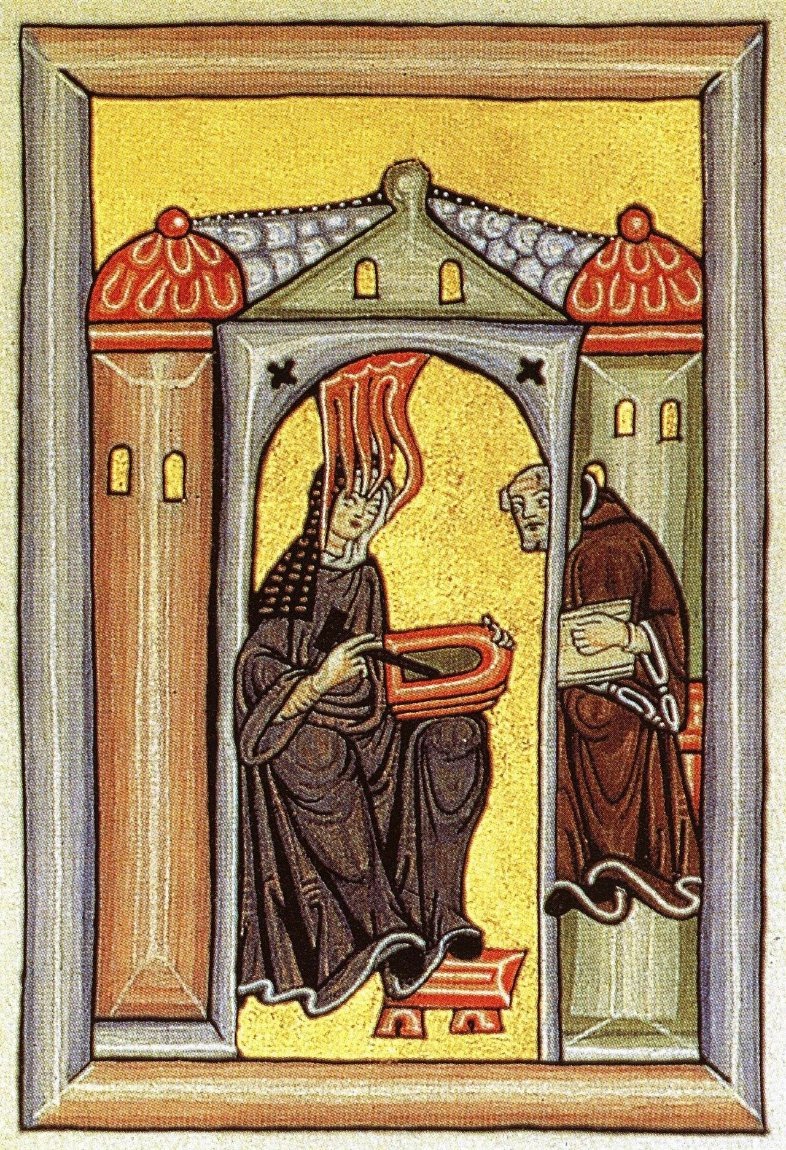
Hildegard of Bingen was a Benedictine abbess, visionary, composer, poet and natural philosopher, and as many-sided a maker as the European Middle Ages produced.
Born into a noble family in the Rhineland, Hildegard was given to the religious life as a child and grew up in the women’s community attached to the monastery of Disibodenberg. She became its leader in 1136, and around 1150 founded her own convent at the Rupertsberg near Bingen, followed by a second house at Eibingen across the Rhine.
From childhood she experienced visions, which she described as a light she called “the shadow of the living light.” In her forties, believing herself commanded to record them, she began the Scivias (“Know the Ways”), completed around 1151 and later illuminated with images of extraordinary strangeness. Two further visionary books followed, the second of which, the Book of Divine Works, presents the human being as a small cosmos at the centre of creation.
Her creative range is almost without parallel. She composed some seventy liturgical songs of soaring, unconventional melody, and the Ordo Virtutum, a sung drama of the soul among the Virtues. She wrote on medicine and the natural world, corresponded with popes and emperors, and devised a secret language, the Lingua Ignota, with its own vocabulary and alphabet. In 2012 she was canonised and named a Doctor of the Church.
What the Order honours in Hildegard is the union of music, image, word and vision in a single sacred work, and the conviction, running through all she made, that creation is a form of praise.