
Ibn Arabi
The greatest master
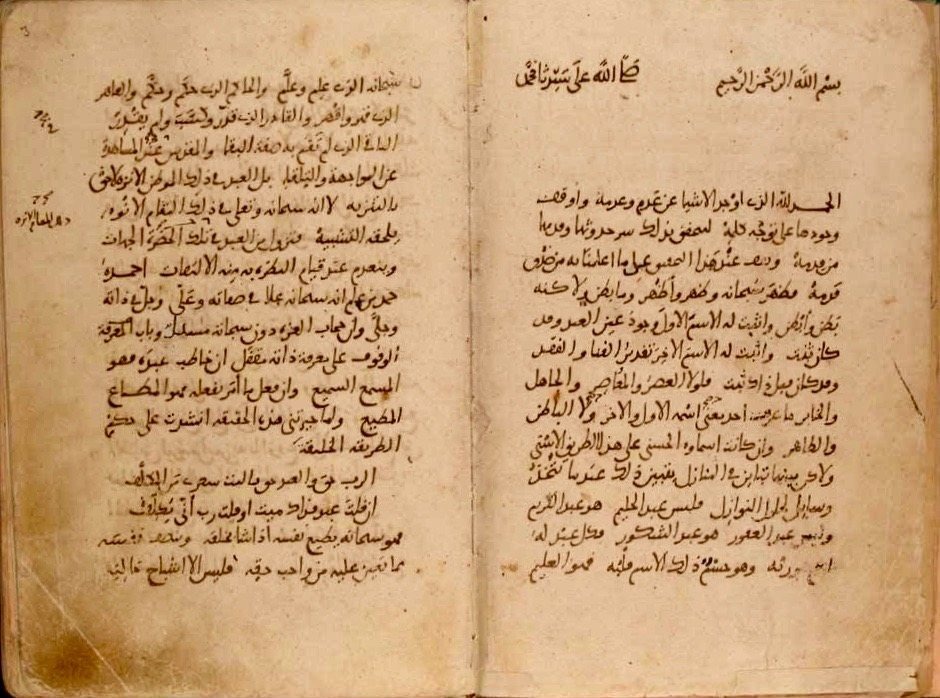
“My heart has become capable of every form: it is a pasture for gazelles and a convent for Christian monks, and a temple for idols and the pilgrim’s Ka‘ba, and the tables of the Torah and the book of the Koran.”
Ibn Arabi, Tarjuman al-ashwaq, XI; trans. R. A. Nicholson, 1911
Muhyi al-Din Ibn Arabi was an Andalusian Sufi mystic, philosopher and poet, known in the Islamic world as al-Shaykh al-Akbar, the Greatest Master.
Born in Murcia in 1165, he grew up in Seville and travelled widely through Spain and North Africa before leaving the West for good around 1200. In Mecca he began his vast Meccan Revelations, a work of some five hundred and sixty chapters; his manuscript of it survives in Konya. He settled finally in Damascus, where he died in 1240 and where his tomb is still visited.
Ibn Arabi taught that all existence is a self-disclosure of the divine, and he gave imagination a central place in his thought: not as fancy, but as a real intermediate world in which the spiritual takes form and the soul meets it. His Bezels of Wisdom reflects on the prophets as facets of a single wisdom, and his love poems, the Interpreter of Desires, were read by him as images of divine love.
His teaching travelled east with his stepson and disciple Sadr al-Din al-Qunawi, who taught in Konya, where he knew the poet Jalal al-Din Rumi. Rumi opened his great Masnavi with a reed flute, cut from its reed bed, whose song is a lament of separation and a longing to return: an image of the soul that has been read, like Ibn Arabi’s poems, in many traditions.
The lines quoted above are among the most celebrated in mystical poetry. The Order reads them alongside its teaching On the Nature of Temples: a heart large enough to honour the sanctuaries of many.