
Kabir
The weaver of Benares
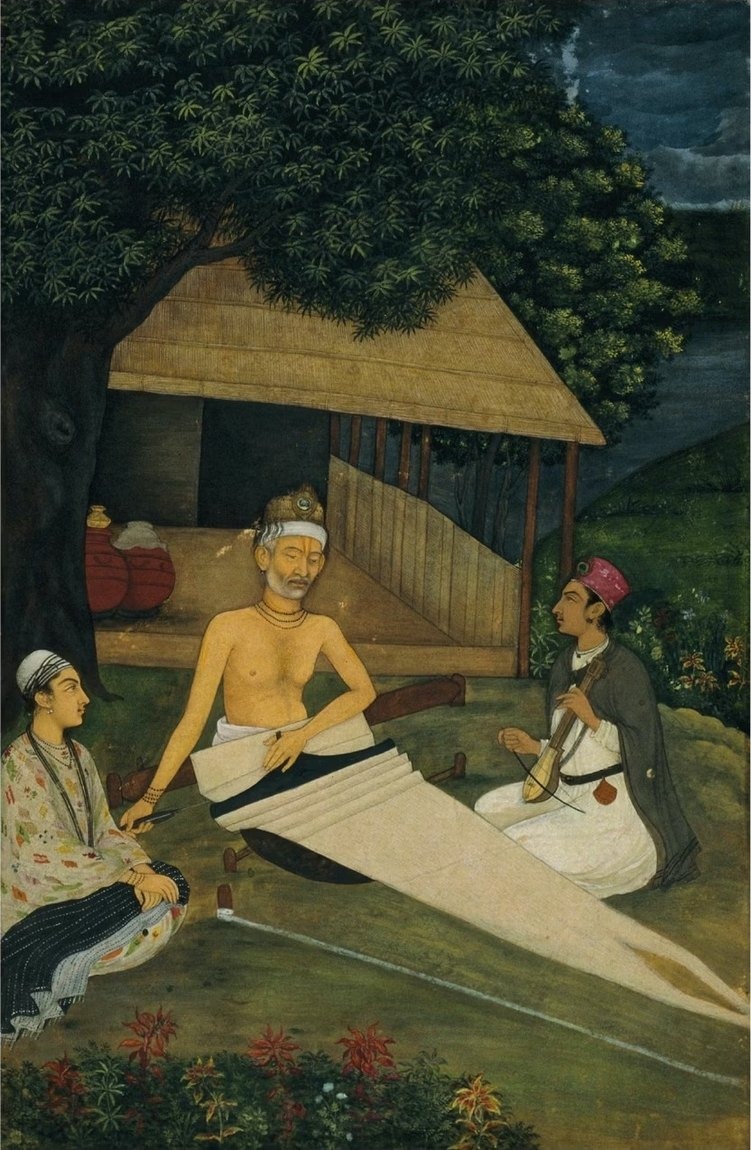
“O servant, where dost thou seek Me? Lo! I am beside thee.”
Kabir, Songs of Kabir I; trans. Rabindranath Tagore, 1915
Kabir was a poet and mystic of fifteenth-century India, a weaver of Benares whose songs are cherished by Hindus, Muslims and Sikhs alike.
Little about his life is certain. He is thought to have lived in the fifteenth century and to have worked at the loom in Benares, the city now called Varanasi, in a family of Muslim weavers. Tradition makes him a disciple of the Hindu teacher Ramananda. He is not known to have written anything down. His poems were sung, remembered and gathered by others, and they survive in several traditions at once.
His couplets and songs are made in the everyday speech of northern India, plain, vivid and often sharp. He mocked empty ritual wherever he found it, among Hindus and Muslims alike, and turned again and again to a divine presence near to every seeker, called by many names: Ram, Hari, Allah. His images come from the life around him, the loom, the potter, the market and the river.
His words live in three traditions. His followers, the Kabir Panth, keep them in the Bijak. The Sikh scripture, the Guru Granth Sahib, includes hundreds of his verses. And a legend tells that at his death at Maghar, Hindus wished to burn his body and Muslims to bury it, until, lifting the shroud, they found only flowers, which they divided between them.
In 1915 Rabindranath Tagore, working with the English writer Evelyn Underhill, published a hundred of his songs in English as Songs of Kabir, and his voice reached readers far beyond India.
Kabir is remembered here as a maker whose songs, sung at the loom in the common tongue, have been received by several faiths as their own, and who heard in all of them one voice; see The Poetic Genius and All Religions are One.