
All Religions are One
Blake’s seven principles of the Poetic Genius
“The Poetic Genius is the true Man, and the body or outward form of Man is derived from the Poetic Genius.”
William Blake, All Religions are One, Principle 1st
All Religions are One is a tiny book of ten etched plates made by William Blake around 1788, in which he set out, in seven short principles, the idea the Order calls the Poetic Genius.
It was among the first works Blake made in his new method of relief etching, in which text and image were drawn together on copper and printed as one. The plates are only a few centimetres high. It survives in a single known copy, now in the Huntington Library in California. A companion work of the same years, There is No Natural Religion, argues that human desire always reaches beyond what the senses can give.
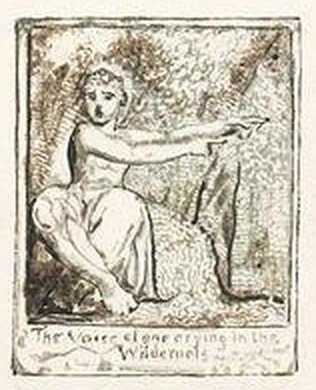
The book opens with a frontispiece of a prophet in the wilderness, and with an Argument: that the true faculty of knowing must be the faculty which experiences. There follow seven Principles. The Poetic Genius is the true human being, and outward forms derive from it. All people are alike in the Poetic Genius, with infinite variety, as they are alike in body. No one can speak from the heart without intending truth, and so every philosophy comes from the Poetic Genius, adapted to each person. Knowledge cannot grow from what is already known alone, and so a universal Poetic Genius must exist.
The last three Principles turn to religion. The religions of all nations derive from each nation’s different reception of the Poetic Genius, which is everywhere called the Spirit of Prophecy. The Jewish and Christian Testaments are an original derivation from it. And as all people are alike, though infinitely various, so all religions have one source: the true Man, the Poetic Genius.
Blake was a young engraver of about thirty when he made it, and he spent the rest of his life working out its thought in the prophetic books and at last in the Laocoön. The Order counts it among the works of its Canon, as the plainest early statement of a conviction it holds as its own: that every faith is a reception of the one faculty through which humanity meets the divine, and that each is to be honoured in its own form; see The Poetic Genius and On the Nature of Temples.