The Laocoön
Blake’s last word on art
“Prayer is the Study of Art. Praise is the Practise of Art.”
William Blake, Laocoön
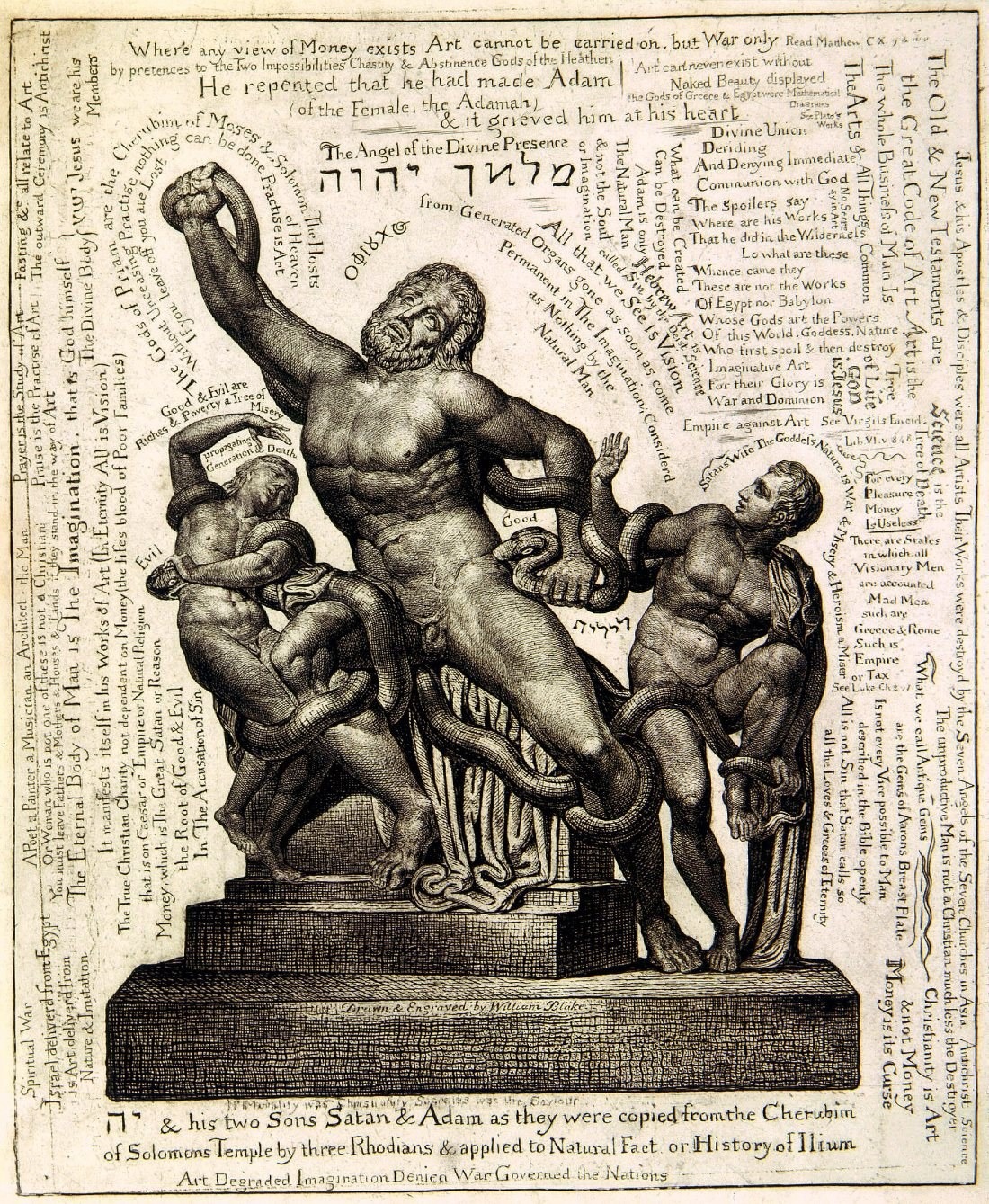
The Laocoön is a single engraved sheet made by William Blake near the end of his life: a picture of an ancient statue, surrounded on every side by his own sayings on art, imagination and the divine. The Order counts it among the works of its Canon.
The statue it shows, Laocoön and his sons struggling with the serpents, was found in a Roman vineyard in 1506 and identified on the spot, in the presence of Michelangelo, as the work praised by Pliny and attributed by him to three sculptors of Rhodes. It became one of the most admired and copied sculptures in Europe, and is kept today in the Vatican.
Blake drew a cast of it at the Royal Academy and engraved it for an encyclopaedia in 1815. Around 1826 or 1827 he returned to the image and made it his own. He renamed the figures “Jah and his two Sons Satan and Adam,” claimed that the Greek sculptors had copied them from a cherub of Solomon’s temple, and filled the margins, in English, Greek and Hebrew, with some of the most concentrated statements he ever wrote. It survives in only a few impressions.
Among them: “The Eternal Body of Man is The Imagination, that is God himself.” “Art is the Tree of Life.” “Prayer is the Study of Art. Praise is the Practise of Art.” “Jesus & his Apostles & Disciples were all Artists.” The sheet reads as the testament of a man who had spent his life making, and who had come to see the act of imagination as the place where the human and the divine are one.
Where the Asclepius calls the human being a great miracle, Blake, at the end of his life, wrote that the imagination is God himself. The Order reads the Laocoön in that long conversation, as the most recent voice in its Canon, and takes from it the words at the head of its entrance. See also William Blake and The Poetic Genius.