
Thomas Taylor
The Platonist
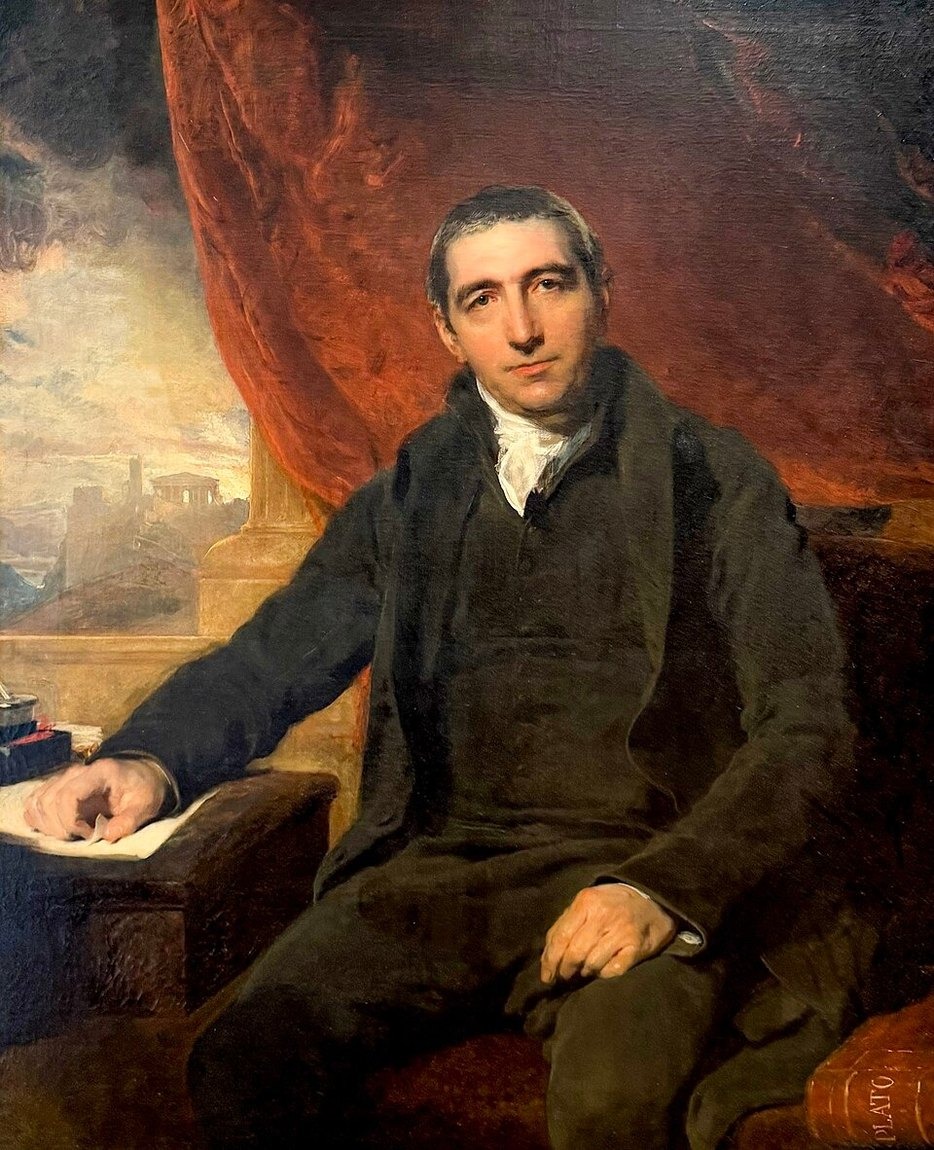
Thomas Taylor was an English scholar who gave his life to translating Plato, Plotinus and the later Platonists into English, and who carried the old Platonic inheritance to the poets of his age.
He was born in London in 1758 and was meant at first for the ministry of a dissenting chapel. He married young and poor, and for years worked as a clerk in a London bank, studying mathematics and Greek at night when the day’s work was done.
In the 1780s he began to lecture on the Platonic philosophy, among other places at the house of the sculptor John Flaxman, whose friends included the young William Blake. In 1787 he published the Orphic hymns and his first piece of Plotinus, the treatise On Beauty. For a time he served as assistant secretary of the Society for the Encouragement of Arts, Manufactures and Commerce, but his life’s work was translation.
It was an immense labour. Taking in Floyer Sydenham’s earlier versions of some of the dialogues, he published the first complete English Plato in 1804, in five volumes, and went on to Aristotle, Proclus, Iamblichus, Porphyry and Pausanias. He translated as a believer, persuaded that the Platonists had kept the true theology of the ancient world, and some called him the English Pagan.
Scholars mocked his Greek, and Blake himself seems to have laughed at him in An Island in the Moon, where a character called Sipsop the Pythagorean is often taken for Taylor. Yet the poets kept reading. His translations reached Blake, Coleridge and Shelley in England; across the Atlantic they were read by Ralph Waldo Emerson and the American Transcendentalists; and a century later W. B. Yeats turned to them again.
He died in London in 1835. The Order remembers Taylor as a link in the Golden Chain: one who received an inheritance few in his country could read, and handed it on in a form that many could; see also Those Who Preserve.