
Plotinus
The sculptor of the soul
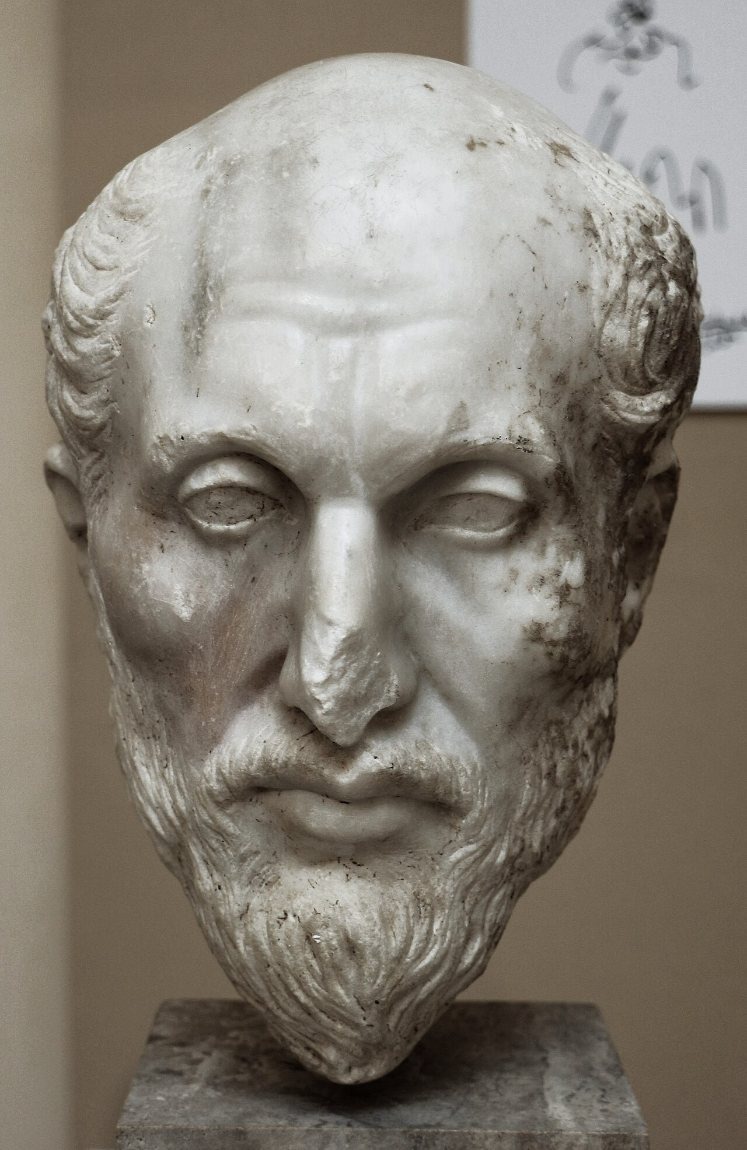
“Never cease working on your own statue, until the godlike splendour of virtue shines out upon you.”
Plotinus, Enneads I.6.9, translated from the Greek
Plotinus was the founder of the philosophy now called Neoplatonism, and one of the most influential mystical thinkers of the ancient world.
He was born in Egypt early in the third century and studied in Alexandria for eleven years under the philosopher Ammonius Saccas. Hoping to learn the wisdom of Persia and India, he joined the emperor Gordian III’s eastern campaign of 243; after the emperor’s death he made his way to Rome, where he taught for the rest of his life. His pupil Porphyry arranged his writings into six groups of nine treatises, the Enneads.
Plotinus taught that all things flow from a single, ineffable source, the One, through Intellect and Soul, and that the soul may return to its source by turning inward. In his treatise On Beauty he tells the reader who cannot yet see his own beauty to act like a sculptor: to cut away, straighten and polish until the statue within shines out.
In 1787 the English Platonist Thomas Taylor chose this treatise for his first translation of Plotinus, and in his English it reached the London of William Blake; see The Golden Chain.
His thought passed into Christian, Jewish and Islamic philosophy, and Ficino translated the Enneads into Latin in 1492. The Order finds in his image of the soul as its own statue an ancestor of Pico’s self-shaping Adam and of Michelangelo’s form hidden in the marble.