
The Muses
Daughters of Memory
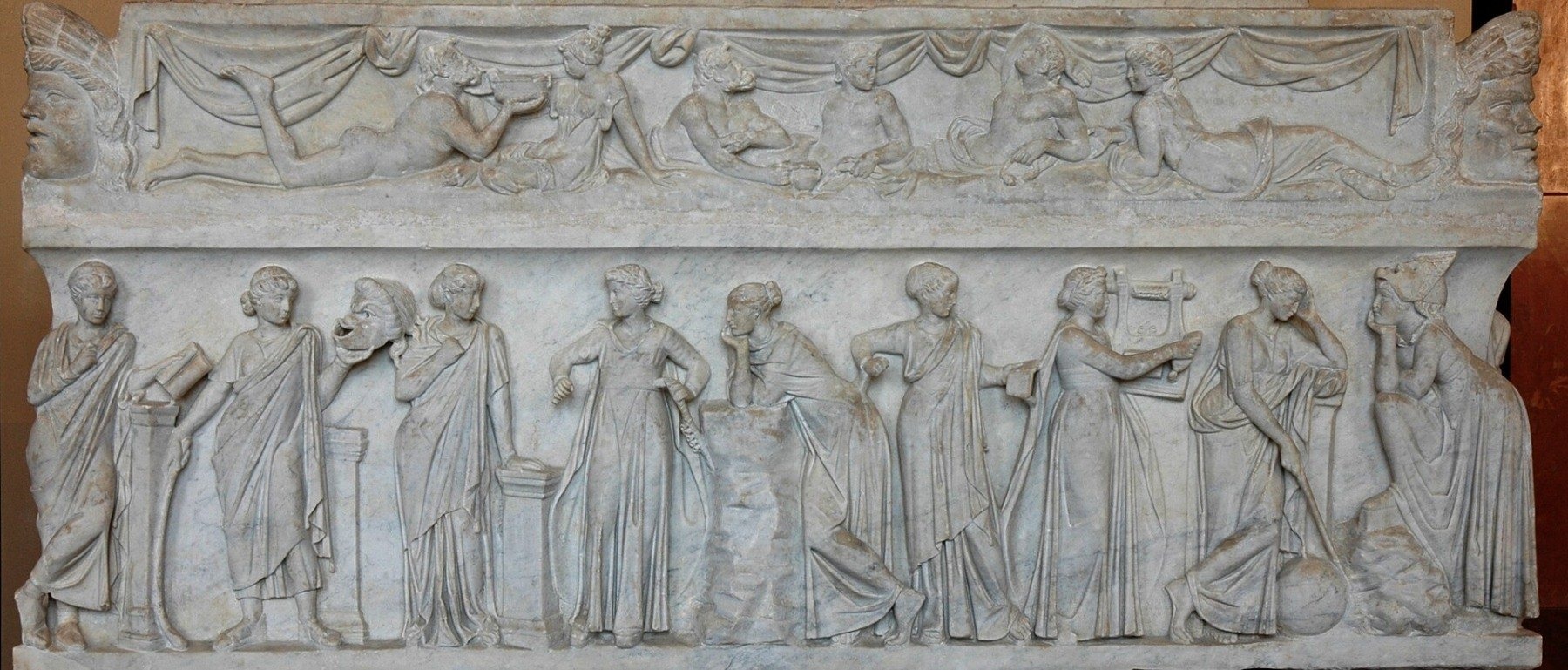
“From the Heliconian Muses let us begin to sing.”
Hesiod, Theogony 1, trans. H. G. Evelyn-White
The Muses were the goddesses of poetry, music and learning in ancient Greece. The Order counts them among the oldest images of something it holds close: that a work first arrives before it is made, and that making is nourished by memory.
Hesiod names them at the beginning of his Theogony: nine daughters of Zeus and Mnemosyne, Memory, who dance on Mount Helicon and sing of the gods. They are Calliope, Clio, Euterpe, Thalia, Melpomene, Terpsichore, Erato, Polyhymnia and Urania. Later ages gave each a province of her own, epic to Calliope, history to Clio, tragedy to Melpomene and the stars to Urania, and so they are shown, each with her attribute, on the Roman sarcophagus illustrated here.
Poets called on them before they began. Homer opens both his epics with a prayer to the Muse, and Hesiod tells how the Muses came to him as he kept sheep and breathed a divine voice into him; see On Inspiration. Virgil and Dante kept the custom, and John Milton’s Heavenly Muse carried it into a Christian poem. An epigram long ascribed to Plato counted Sappho of Lesbos, whose songs survive only in fragments, as the tenth Muse.
Their name lives on in our words. Music was for the Greeks the art of the Muses, mousikē. The Mouseion of Alexandria, home of the great Library, was their shrine, and every museum since has borne their name; see Temples of Knowledge.
India knows a goddess of the same gifts. Saraswati, whose name is also that of a sacred river, is the goddess of knowledge, music, speech and the arts. She is shown in white, seated with a vina, a book and a string of beads, often with a swan beside her, and early texts join her with Vac, Speech herself. Each spring, at the festival of Vasant Panchami, students and artists lay their books and instruments before her. The Muses of Greece and the goddess of the river were never known to each other, yet each people, reaching for the source of its songs, found a goddess of learning and of art.
The Order dwells above all on their parentage. The Muses are the children of Memory. What a maker receives in the moment of inspiration draws on all that has been kept, seen and remembered, and what is preserved feeds what is yet to be made. The Order reads in them the bond between creation and preservation that its motto sets side by side; see To Create, To Preserve, To Uphold and The Art of Memory.