Homer
The poet of the Iliad and the Odyssey
“Sing, goddess, of the wrath of Achilles, son of Peleus.”
Homer, Iliad I.1, translated from the Greek
Homer is the name the Greeks gave to the poet of the Iliad and the Odyssey, the oldest works of European literature and, for the ancient world, the beginning of all poetry.
Nothing certain is known of him. The Greeks placed him in Ionia, on the coast of what is now Turkey, and seven cities claimed to be his birthplace. Tradition made him blind. Modern scholars date the poems to the eighth or seventh century BC and see behind them a long tradition of oral poetry. In the 1930s the American scholar Milman Parry and his student Albert Lord, recording singers of epic in Yugoslavia, showed how such poems could be composed in performance from a great store of traditional phrases.
Both poems open by calling on the Muse. The Iliad tells of a few weeks in the tenth year of the Trojan War and of the wrath of Achilles; the Odyssey, of the ten years’ wandering of Odysseus on his way home to Ithaca. Together they gave the Greeks their gods, their heroes and much of their language of honour, grief and cunning. Plato reported that Homer was praised as the educator of Greece, even as he argued that poets should be banished from his ideal city, and Alexander the Great is said to have carried an Iliad on campaign in a precious casket.
He was also the first poet to be honoured as a god. Ptolemy IV built him a shrine in Alexandria, and a relief carved by Archelaus of Priene shows him enthroned and crowned while the world pays him homage. Centuries later Ingres painted the same scene for the Louvre; see On Apotheosis.
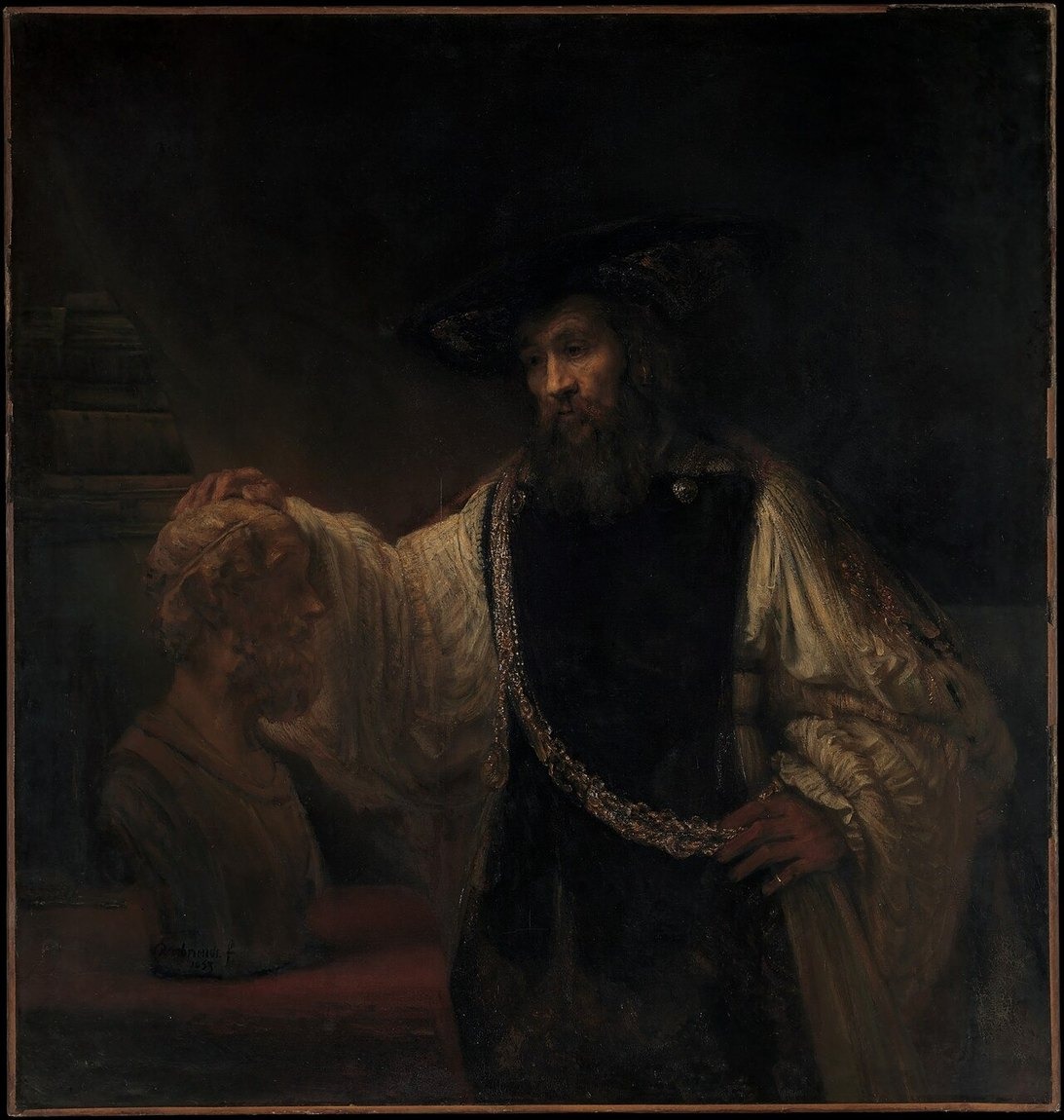
It was from the Iliad, too, that the late Platonists took the image of the golden chain. In Rembrandt’s painting, Aristotle, the greatest of Plato’s pupils, rests his hand on a bust of Homer: the philosopher in the presence of the poet. The Order holds Homer as the first of the makers whose works outlived every trace of their lives. Of the man almost nothing remains; of the poems, nothing has been lost; see also Works That Come Alive.