On Apotheosis
The name of the Order
“The human being passes into the nature of a god, as though it were itself a god.”
Asclepius 6, translated from the Latin
Apotheosis, from the Greek apotheōsis, “making divine,” is the raising of a human being to the rank of a god. The Apotheotic Order, also called the Order of Apotheon, takes its name from the word, and understands by it the end toward which its fellowship is directed: the approach of humanity to the divine through creation.
In the ancient world apotheosis was a public honour. Hellenistic kings were worshipped as gods, and in Rome the Senate could vote that a dead emperor be counted among the gods of the state; at his funeral an eagle was released above the pyre to carry his spirit to the heavens. Poets were honoured in the same language. Ptolemy IV built a shrine to Homer in Alexandria, and a relief carved by Archelaus of Priene, now in the British Museum, shows the poet enthroned and crowned, with Time standing at his side.
The oldest surviving story of a mortal who sought to become like the gods ends otherwise. Gilgamesh fails to win eternal life and returns home to find his immortality in the walls of the city he built.
Christian thought kept the idea in another form. The theologians of the Greek East spoke of theosis, the deification of the human being, and Athanasius of Alexandria wrote that the Word of God became human so that humanity might become divine. For these writers deification is a sharing in the divine life, received as a gift, and the Orthodox churches teach it still.
India gave the thought yet another form. In the Chandogya Upanishad a father teaches his son that the finest essence of all things, the Self of the whole world, is his own self too: “thou, O Svetaketu, art it.” For the schools of Vedanta that grew from such teachings, the aim of life is to realise that identity. The Buddhists, holding that there is no lasting self to be raised, sought instead the awakening that gave the Buddha his name.
The Hermetic writings approach it from a direction of their own. In the eleventh treatise of the Corpus Hermeticum the mind is told that it cannot understand God unless it makes itself like God. Plotinus urged his readers to work on their own statue until the godlike splendour shone out, and Pico della Mirandola imagined Adam free to rise, by his own choice, into the higher forms, which are divine.
The Order reads these inheritances together. The power the ancients granted most readily to their gods was the power to make: to bring forth a world, a living form, a thing that had not been. Human beings exercise that power whenever they create, and in doing so they do on a human scale what the old stories told of the gods. More than this, it is in minds like theirs that the world comes to mean something, whether its meaning was placed there or first made there. Apotheosis, for the Order, is approached through this faculty. It is the direction of a life given to making, a movement toward the divine that each work carries a little further.
It is approached by partaking as well as by making. Whoever enters fully into a great work, a poem, a cathedral, a piece of music, shares for a time in the act that made it and is changed by it; see the First and Second Breath. The encouragement and reception of art therefore belong to the same road as its creation; see To Create, To Preserve, To Uphold. Rainer Maria Rilke, standing before a broken statue of Apollo in the Louvre, ended his poem on it with the words: “You must change your life.”
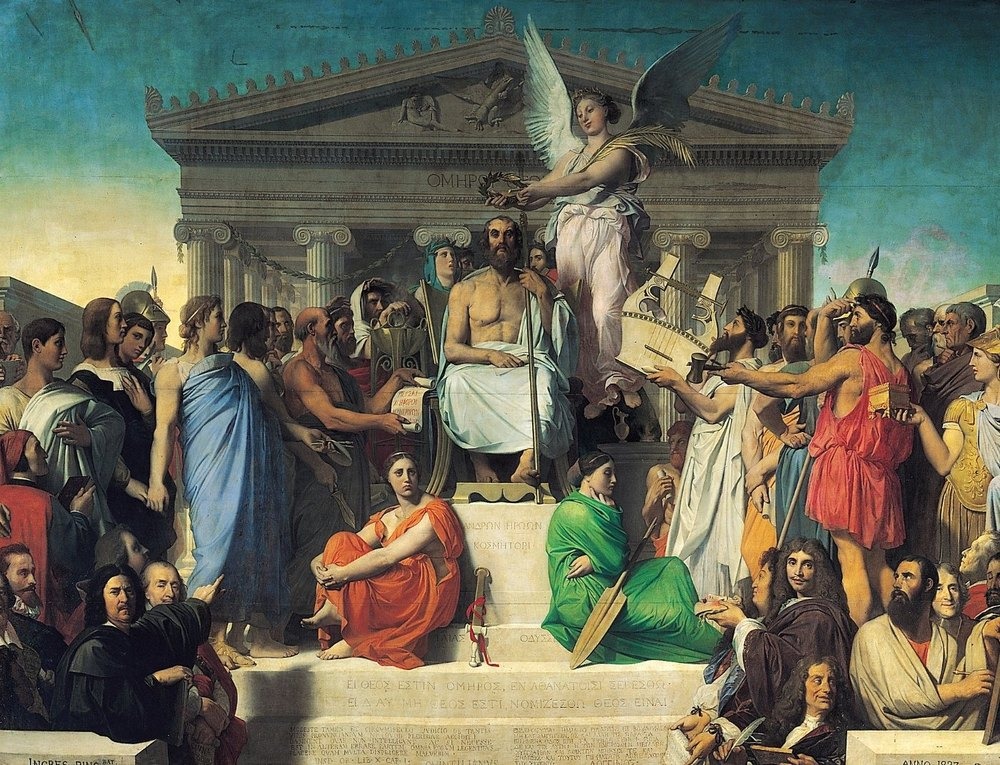
Later ages raised their poets to the heavens in paint. In 1827 Jean-Auguste-Dominique Ingres painted The Apotheosis of Homer for a ceiling in the Louvre: the poet enthroned before a temple and crowned by Victory, with the makers of later ages, among them Dante and Shakespeare, gathered on the steps below. What such pictures raise is the maker through the work, which outlives its maker and goes on giving. The Order’s Roll of Honour belongs to the same tradition.
What the maker approaches is left to individual conviction. For one it is the Creator in whose image humanity was made; for another, the highest that the human mind can conceive; see The Supreme Divine. The road is the same, and it runs through the sacred faculty the Order exists to cultivate.