Leonardo da Vinci
The inquiring eye
Leonardo da Vinci was a painter, draughtsman, engineer and student of nature, for many the fullest embodiment of the creative and inquiring mind of the Renaissance.
Born at Vinci in 1452, the son of a notary, Leonardo trained in the Florentine workshop of Andrea del Verrocchio. He worked for the Sforza court in Milan, where he painted the Last Supper, and later in Florence, Rome and finally France, where he died at Amboise in 1519 as a guest of King Francis I.
Relatively few paintings by him survive, the Mona Lisa among them, but his notebooks, thousands of pages written in mirror script, record a lifetime of observation and invention: studies of anatomy, water, flight, light, plants and machines, as well as designs for buildings and devices far ahead of their time.
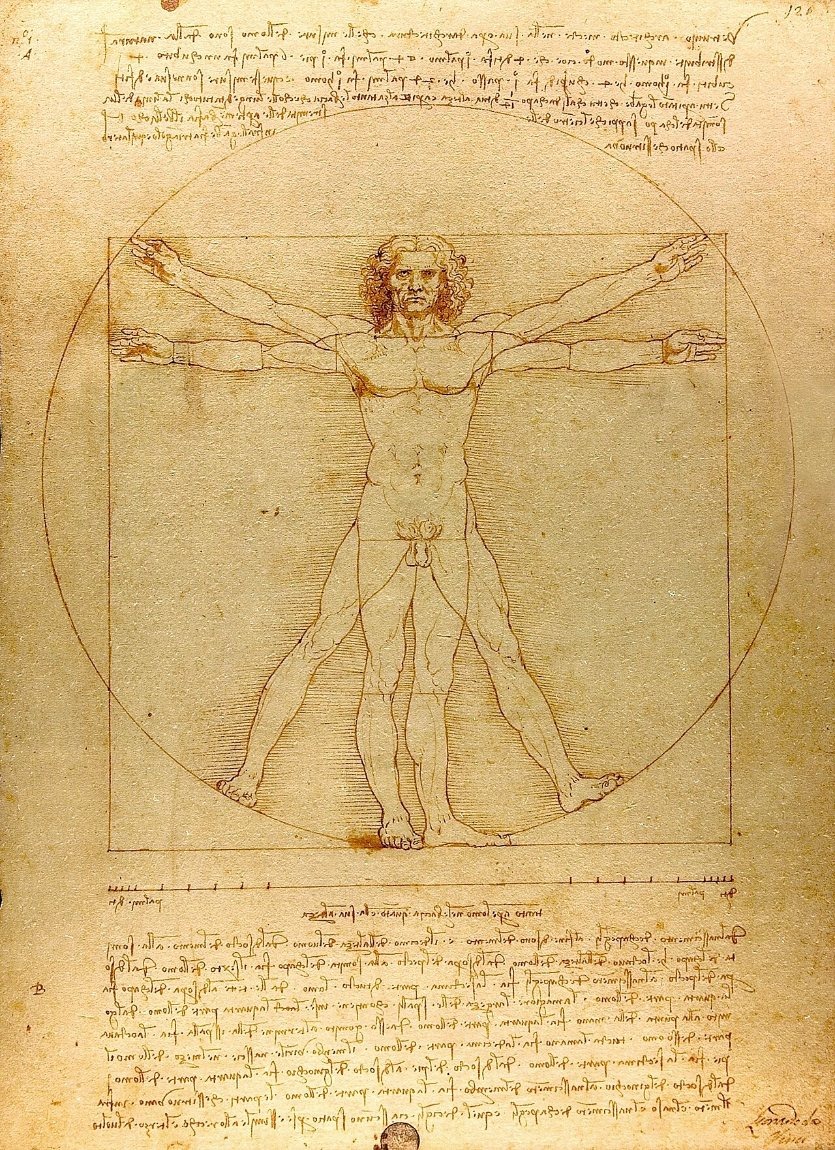
The Vitruvian Man, drawn around 1490 after a passage in the Roman architect Vitruvius, shows a human figure inscribed in both a circle and a square, the proportions of the body answering to the geometry of the world. For Leonardo, seeing and making were one discipline. He remains, for many, the fullest image of the Renaissance mind: one for whom there was no border between art and inquiry.