
Zhuangzi
The cook, the woodworker and the butterfly
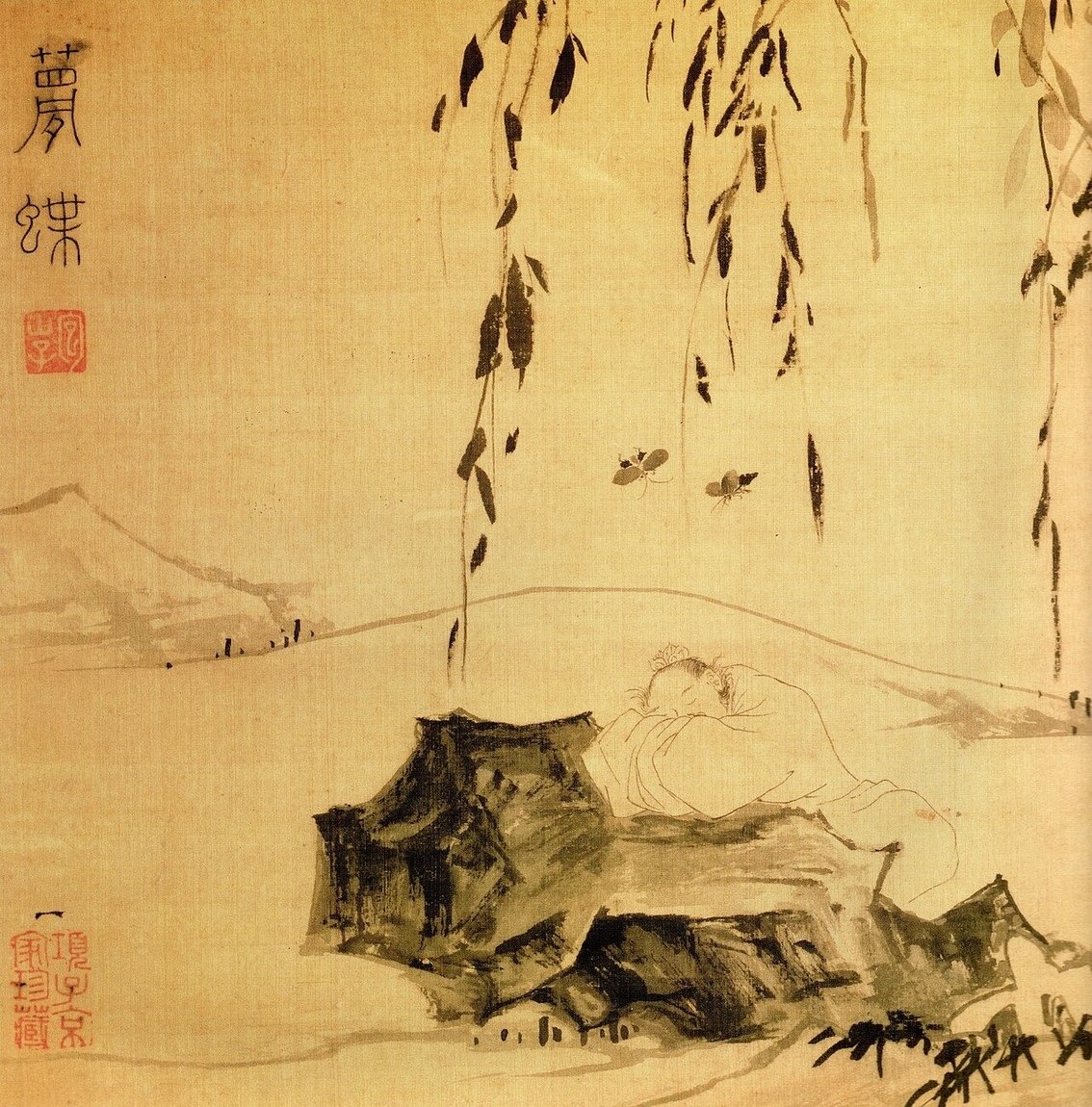
“I do not know whether I was then Zhuang Zhou dreaming that I was a butterfly, or whether I am now a butterfly dreaming that I am Zhuang Zhou.”
Zhuangzi, chapter 2, after the translation of James Legge, 1891
Zhuangzi was a Chinese philosopher of the fourth century BC, and, with Laozi, the great teacher of the Dao, the Way. The book that bears his name is full of stories, and a few of them say more about the art of making than whole treatises.
Little is known of his life. He lived in the Warring States period, was for a time a minor official in the town of Meng, and is said to have refused the office of chief minister because he would rather be a turtle dragging its tail in the mud than a sacred shell kept in a temple. The first seven chapters of the book are thought to be his own; the rest were added by his followers.
In one story Cook Ding carves an ox for his lord. Every movement of his hands and shoulders falls into rhythm, as if he were dancing. When the lord praises his skill, the cook answers that what he cares about is the Way, which goes beyond skill. He no longer sees the ox with his eyes but meets it with his spirit, and his blade slips through the natural spaces of the joints. For nineteen years he has used the same knife, and it is as sharp as if it had just come from the whetstone.
In another, the woodworker Qing carves a bell stand so fine that people think it the work of spirits. Before he begins, he explains, he fasts to still his mind: after three days he forgets reward, after five days praise and blame, after seven days his own body. Only then does he go into the forest, and when he finds the right tree he sees the bell stand already there within it, and puts his hand to the work.
At the end of the second chapter Zhuangzi dreams that he is a butterfly, fluttering about happily, knowing nothing of Zhuangzi. He wakes and is Zhuangzi again, and cannot tell whether he is a man who dreamed he was a butterfly or a butterfly now dreaming he is a man. This, he says, is the transformation of things.
The Order honours in these stories a way of making that is also a way of life: skill carried until it becomes stillness and freedom. The woodworker who sees the bell stand in the living tree is a brother to Michelangelo, who saw the figure in the marble; and the dreaming sage belongs with the dreaming god of India; see On Divine Play and The Precepts.